Headphones and earbuds
Best Wired Headphones for Home Listening and Desk Setups
A wired headphone should make a desk setup easier to live with. It should reach the socket, stay comfortable through the session and work from the source you own.

James Carter is an editorial pen name for Sound Mic Test's headphone coverage. Articles under this byline focus on comfort, isolation, connectivity and the everyday trade-offs between different headphone designs.
Sound Mic Test editorial pen name.
james.carter@soundmictest.com
A wired headphone should make a desk setup easier to live with. It should reach the socket, stay comfortable through the session and work from the source you own. Open-back headphones are a good starting point for a quiet room; closed-back models make more sense when you share the space or record near a microphone.
The practical shortlist here includes Sennheiser HD 560S for an open design, Audio-Technica ATH-M20x for straightforward closed-back listening, and a wired gaming headset when voice chat is part of the job. These recommendations compare documented construction and connection choices. They are not a claim that every model was listened to under identical conditions.
Decide whether the room can hear your music
| Need | Design to consider | Example |
|---|---|---|
| Quiet home listening | Open-back headphone | Sennheiser HD 560S |
| Shared desk or recording | Closed-back headphone | Audio-Technica ATH-M20x |
| Gaming and calls | Headphone with boom microphone | HyperX Cloud III wired |
| Phone with no headphone socket | Analog headphone plus compatible DAC adapter | Check microphone support separately |
Open-back cups allow sound to pass in both directions. That can be entirely reasonable in a private room and irritating in a shared office. They do not remove the need to consider background noise. A dishwasher, loud computer fan or television can remain audible through the music.
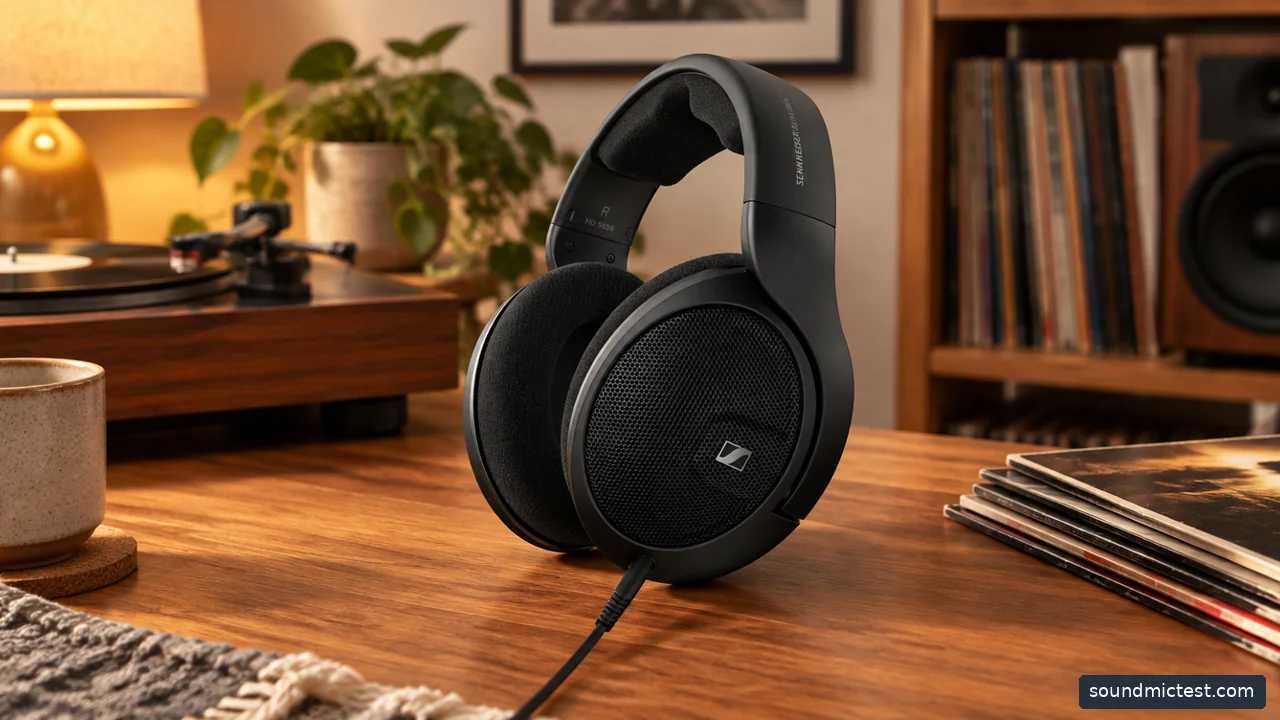
Open-back wired headphones suit quiet spaces where sound leakage is acceptable. Editorial illustration.
HD 560S: a home-listening starting point
The Sennheiser HD 560S uses an open-back design, a removable cable and an adapter for larger headphone sockets. That arrangement suits a desk where you may move between a computer, an interface and a headphone amplifier.
Its appeal is the complete listening arrangement rather than a long list of wireless functions. There is no pairing routine or headphone battery to manage. The limitations are equally clear: sound leakage, no built-in boom microphone and less separation from the room than a closed design.
Do not buy an amplifier from impedance alone. Check whether your existing output delivers the volume you need cleanly, with sensible adjustment range. If the source is already adequate, an additional box may solve no practical problem. Conversely, a weak or noisy output can justify a better source even when the headphone itself is inexpensive.
Closed-back headphones for a shared workspace
The ATH-M20x represents the conventional closed-back studio-headphone approach. It keeps the shopping decision focused on passive listening rather than applications, batteries and wireless modes. Check cable length and attachment carefully: a studio-oriented lead can be convenient at a recording desk and cumbersome beside a phone.
Closed construction does not mean complete silence. It also does not guarantee that a microphone beside your mouth will ignore music leaking from the cushions. Monitor at a moderate level and make a short recording if you are using the headphones during speech or vocal work.
For a removable-cable alternative, our ATH-M40x setup guide explains another route. Choose between the models on the full setup cost and cable arrangement, not simply because the higher model number looks more professional.
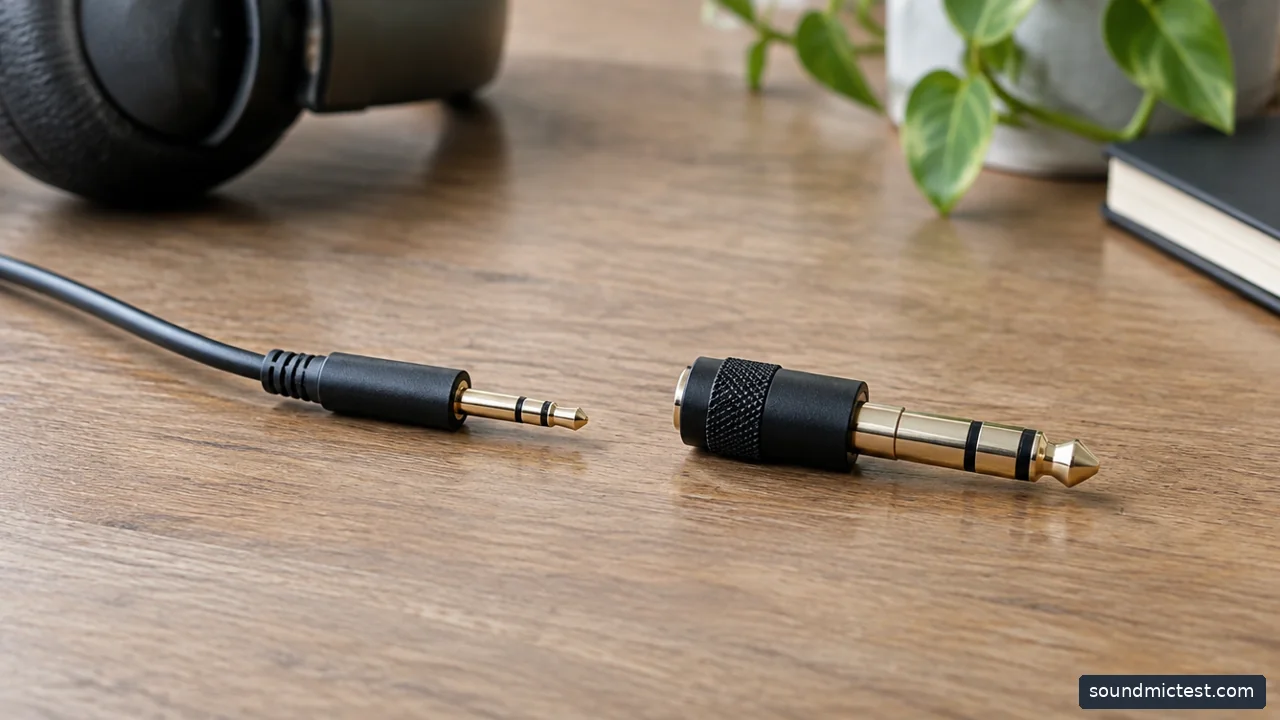
A 3.5mm headphone plug beside a separate 6.35mm adapter, realistic proportions. Editorial illustration.
Add the microphone before adding accessories
If you regularly join calls or play multiplayer games, a separate microphone changes the cost comparison. The HyperX Cloud III wired includes a detachable boom microphone and analog and USB connection options. That can be more convenient than combining a listening headphone, a desk microphone, a stand and another cable.
The trade-off is specialization. A headset's controls and boom are useful for communication but may be unnecessary for quiet music listening. If you already own a suitable microphone, there is no need to purchase that function again. Keep the listening and recording paths separate in your comparison so a cheap headphone does not become an unexpectedly expensive complete system.
Check the socket and the cable route
A 6.35mm adapter changes the plug size; it does not improve the audio signal. A balanced-looking connector does not make every headphone cable interchangeable either. Follow the headphone and amplifier documentation rather than building an adapter chain from connector shapes alone.
For a laptop with one combined jack, confirm whether the plug carries listening audio only or includes microphone contacts. For a desktop with separate sockets, identify the correct output before connecting. Keep enough slack that standing up does not pull the computer or interface across the desk.
The stereo test is useful for checking channel orientation after changing cables. If speech recording is involved, the voice recorder can help reveal a wrong input selection or obvious headphone leakage. Neither tool establishes frequency response or amplifier performance.
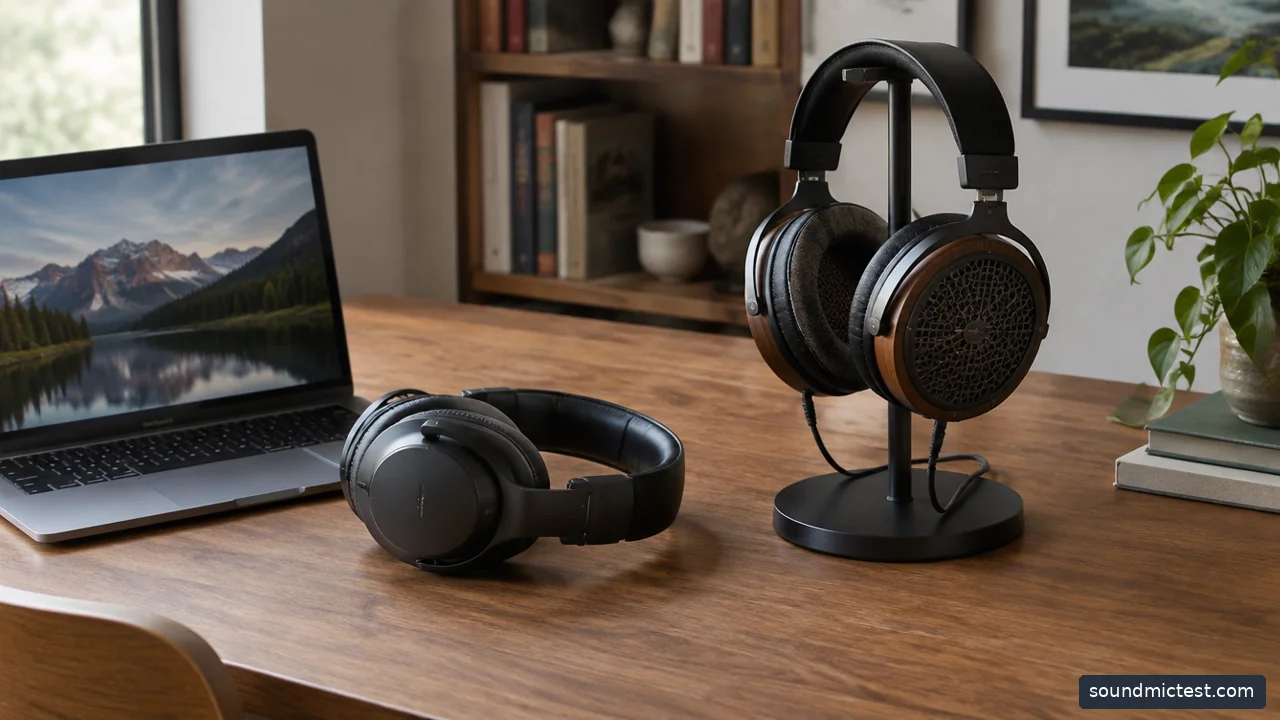
Closed-back headphones beside a laptop and open-back headphones on a stand. Editorial illustration.
Make the first evening a practical audition
Use the headphones with your normal glasses and chair position. Check whether the cable rubs against the desk and whether the cushions become distracting before the session ends. Compare familiar material at similar, comfortable levels rather than assuming the louder option is better.
Choose open-back headphones for a quiet private room, closed-back headphones for a shared environment, and a wired headset when communication is integral to the setup. Once those requirements are satisfied, sound preference and comfort can guide the final choice without being undermined by a connection problem you could have caught earlier.