Soundbars
Best Soundbars: Find the Right Setup for Your Room
The right soundbar should fit your television, room and listening habits before it fills a specification table. A compact bar can make everyday viewing more convenient, while a larger system may add a separate subwoofer and rear speakers.

Sophie Brooks is an editorial pen name for home-audio coverage at Sound Mic Test. This byline focuses on soundbars, living-room audio systems, television connections and making sense of home-listening features.
Sound Mic Test editorial pen name.
sophie.brooks@soundmictest.com
The right soundbar should fit your television, room and listening habits before it fills a specification table. A compact bar can make everyday viewing more convenient, while a larger system may add a separate subwoofer and rear speakers. Buying the most complicated option is not automatically an upgrade if there is nowhere sensible to put the extra boxes.
Start by deciding whether your priority is dialogue, film immersion or a system that can expand later. Then inspect the television's audio outputs. This guide uses manufacturer documentation to explain representative options and their trade-offs; it does not claim a room-by-room listening contest or a universal winner.
Match the system to the room
| Situation | Useful starting point | Limitation to consider |
|---|---|---|
| Small room, basic television audio | Compact optical bar such as Sonos Ray | Connection and format options are limited |
| Compact room with HDMI audio | Sonos Beam Gen 2, where available | Subwoofer and rears cost extra |
| Expandable home theater | Current Sonos home-theater range | Total system price can grow quickly |
| Bass is the missing ingredient | Compatible bar plus separate subwoofer | Floor space and neighbor considerations |
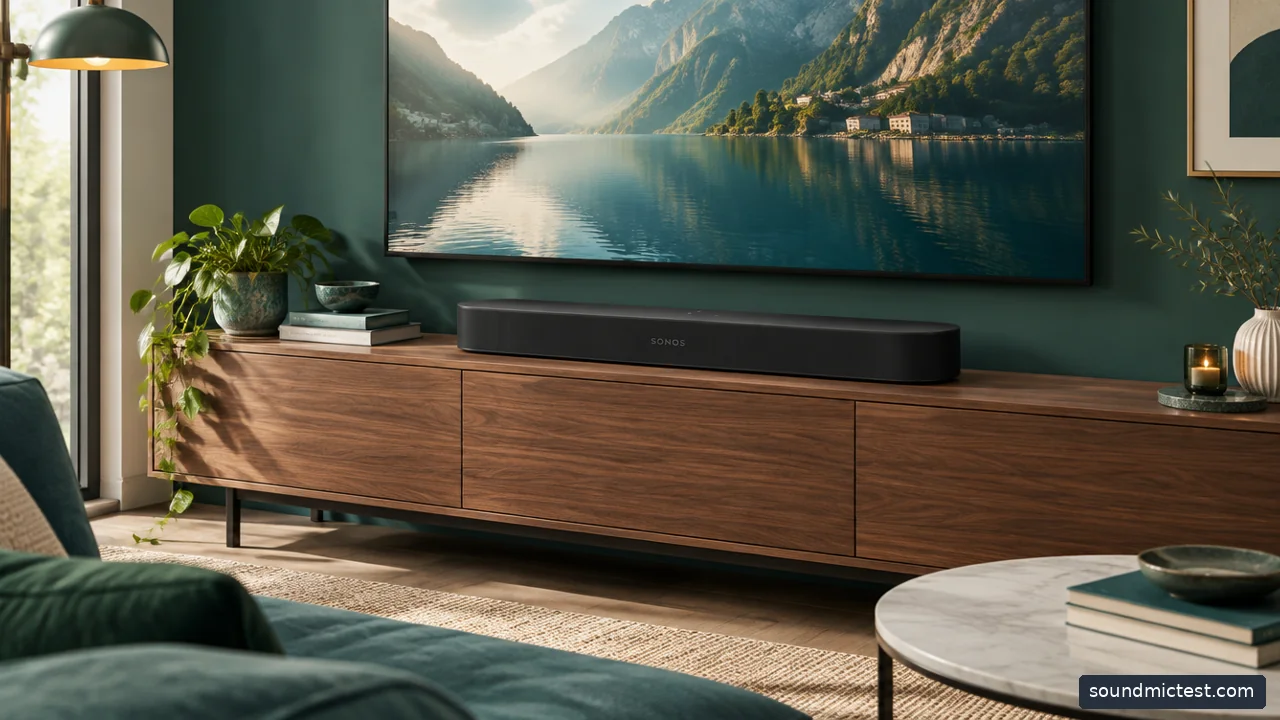
A compact soundbar can simplify TV audio, but the TV connection determines available formats. Editorial illustration.
A compact bar for everyday television
Sonos Ray is an example of a small soundbar built around an optical television connection. That can suit a television whose optical output is available and whose owner wants a simple front speaker arrangement. Before buying, check the TV's output settings and how your remote will control volume.
Its compact size is not a substitute for compatible audio formats. Do not buy an optical bar expecting all the features associated with an HDMI eARC system. If your main complaint is that speech is difficult to follow, also inspect the bar's dialogue and night-listening controls rather than focusing only on the number of drivers.
Placement remains important. Put the bar where its front is unobstructed, and avoid hiding it behind decorative objects. A small improvement to the location can be more useful than choosing a more expensive model and then burying it in a cabinet.
HDMI makes the television part of the decision
The Beam Gen 2 is a useful compact HDMI-based reference point, particularly for an existing system or remaining stock. Sonos now also lists newer products in its current home-theater range, so compare the exact generation and current bundle rather than treating every Beam listing as the same device.
Look for a television port labeled ARC or eARC. An ordinary HDMI input is not equivalent. The TV, source device, streaming service and selected audio track all contribute to the format that reaches the soundbar. Paying for an Atmos-capable product does not turn every broadcast into an Atmos soundtrack.
If you have several consoles or players, count the television's remaining inputs. Some bars rely on the TV to collect all sources rather than providing a bank of passthrough inputs. This is a practical compatibility question, not a minor detail to discover after mounting the television.
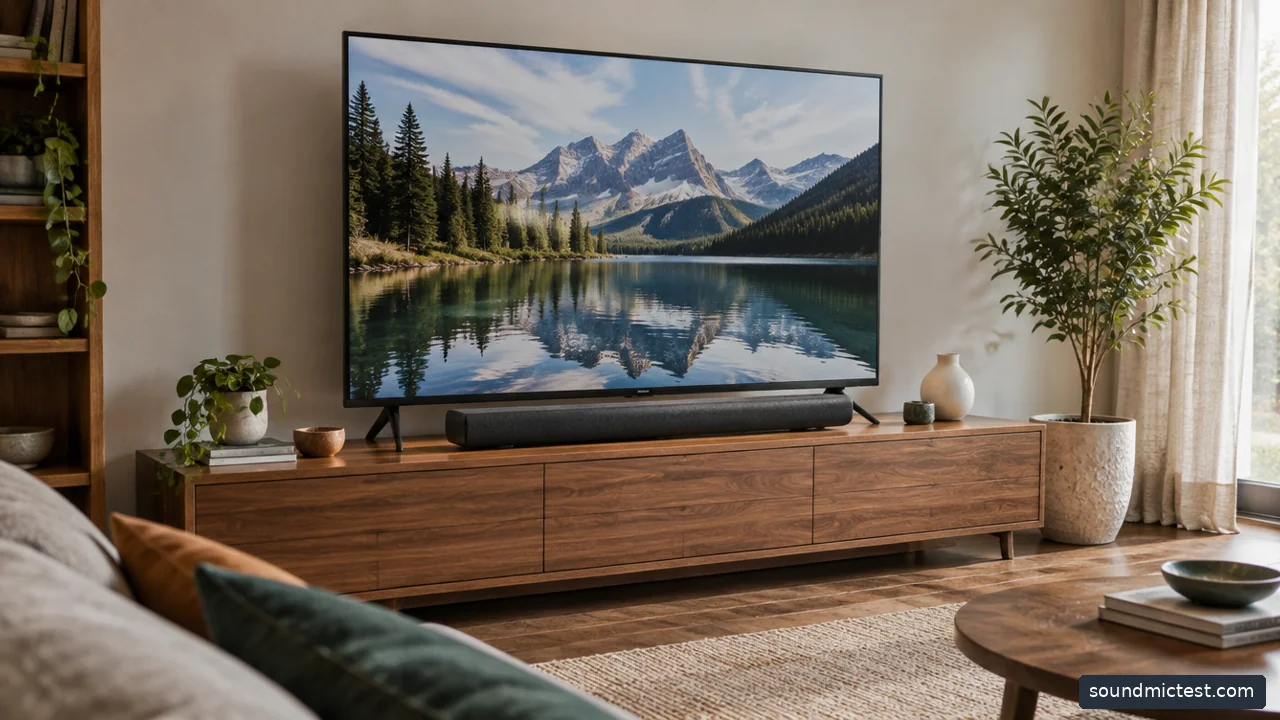
A soundbar placed in front of a television without obstructing its screen. Editorial illustration.
When a separate subwoofer makes sense
A subwoofer is worth considering when you want more low-frequency presence than a compact bar can provide by itself. It also creates another placement problem. The most convenient empty corner is not always the location that produces the most even bass at the sofa.
Sonos lists Sub Mini compatibility separately. Check that list before assuming any wireless speaker can pair with any subwoofer. A product using Wi-Fi or Bluetooth is not automatically part of the same home-theater system.
For an apartment, consider whether you would actually use the additional bass at your usual listening hours. Dialogue-focused viewing at modest volume may not justify the expense or floor space. If you do add a sub, begin with restrained output and listen from the seats you use, rather than setting it entirely from a standing position beside the unit.
Rear speakers are a room commitment
Wireless surrounds still need power. Before choosing a bundle, identify safe outlet locations and a place for each speaker that does not obstruct a walkway. A system photograph can hide the cables, stands and furniture compromises that become obvious in a real living room.
Rear speakers also make less sense when the sofa is positioned awkwardly or the room is used mainly for background news. Spend according to the content you watch. A viewer who regularly sits down for films has different priorities from someone following dialogue while cooking in an adjoining room.
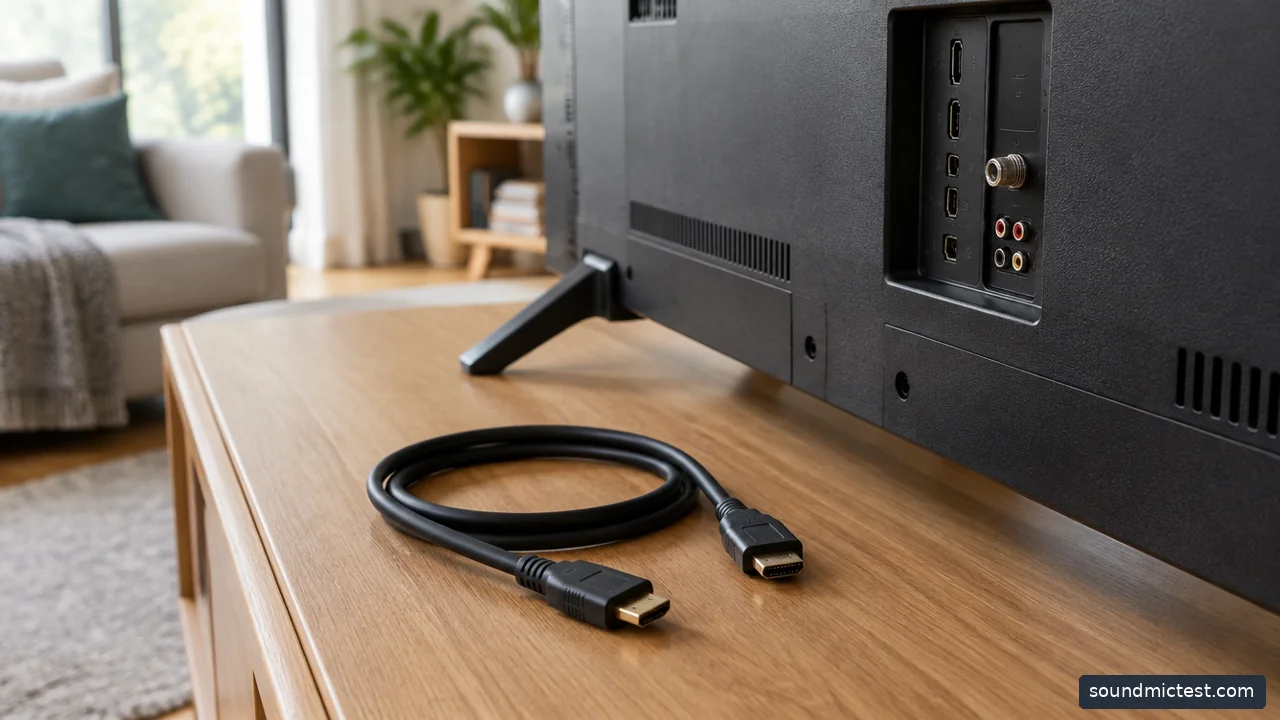
HDMI cable beside a television viewed from behind, connectors not plugged in. Editorial illustration.
Set up the system before judging the purchase
Connect the bar to the intended television output, choose the TV's external-audio setting and confirm that the remote changes the correct volume. Then try a familiar dialogue scene at an ordinary level. Compare any speech or night mode one at a time so you know which setting caused the change.
The speaker test can help confirm browser playback through the selected output. It cannot establish Atmos compatibility or calibrate a living room. For those questions, use the television and soundbar manuals and the system's own setup process.
Choose a compact bar when size and dialogue matter most, an HDMI model when its connection and format support fit the television, and an expandable system only when the room can accommodate it. The useful upgrade is the one that solves the problem you hear every evening without creating a new set of equipment frustrations.