Headphones
Best Headphones: A Buying Guide by Budget and Use
Start with your main use, then narrow the headphone category, connections and budget before comparing specific models.

James Carter is an editorial pen name for Sound Mic Test's headphone coverage. Articles under this byline focus on comfort, isolation, connectivity and the everyday trade-offs between different headphone designs.
Sound Mic Test editorial pen name.
james.carter@soundmictest.com
The phrase "best headphones" hides the most important part of the decision: best for what? A private listening room, an open office, a gaming console and a gym have different requirements. Spending more can buy useful features, but it can also buy a design that is less suitable for your day.
Use this guide as a route through the categories. The model examples are based on manufacturer documentation and specific use cases, not a claim that one product wins every sound-quality comparison. Start with your main activity, set a budget for the complete setup and then compare a short list within the right category.
Choose the category before the model
| Main use | Design to investigate | Example to research |
|---|---|---|
| Travel and shared workspaces | Wireless over-ear with ANC | Sony WH-1000XM6 |
| Quiet home listening | Open-back wired | Sennheiser HD 560S |
| Wired desk listening | Closed-back wired | Audio-Technica ATH-M50x |
| Calls and commuting | Well-fitting wireless earbuds | AirPods Pro 3 or Sony WF-1000XM6 |
| Gaming with chat | Platform-compatible headset | Arctis Nova 7 Gen 2 family |
| Exercise | Stable sports or open-ear design | Powerbeats Pro 2 or OpenRun Pro 2 |
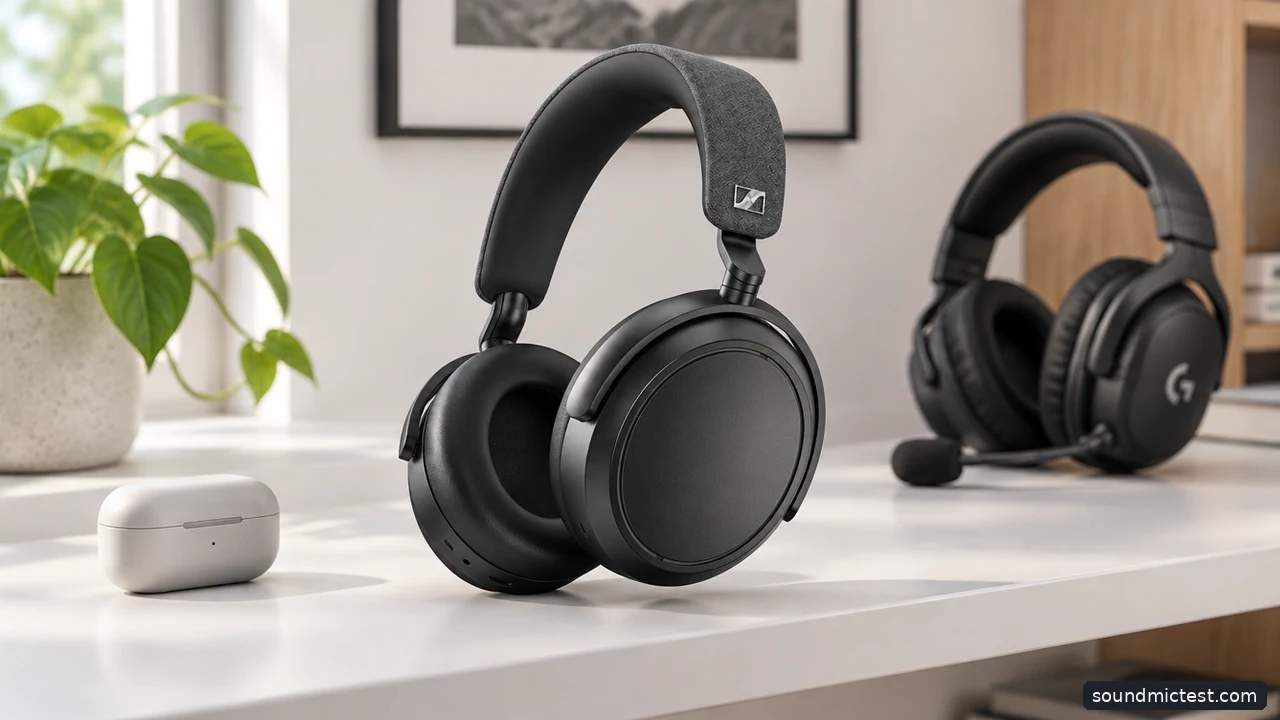
Start by choosing the right category for the main use. Editorial illustration.
A small budget: pay for the essentials
At the lower end of the market, fit, connection reliability and support deserve more attention than a long feature list. A wired pair can avoid charging entirely, while inexpensive wireless earbuds trade that simplicity for freedom from a cable.
Set the budget around the final cost. Include a needed adapter, shipping and any replacement tips. A product advertised below your limit may exceed it after those additions. Avoid spending the entire allowance on a feature you cannot use with your phone or computer.
Price alone does not tell you whether an item is good value. An inexpensive pair used every day can be a better purchase than a heavily discounted premium model with the wrong connection. Check the exact product generation, seller and warranty rather than treating the size of the discount as the main attraction.
Travel and work: prioritize the daily routine
For an over-ear option, the Sony WH-1000XM6 specification includes multipoint and an analog input. Those are useful reasons to investigate it when the same pair must serve a laptop, a phone and occasional wired playback.
The Bose QuietComfort Ultra Headphones (2nd Gen) adds another route to consider through USB audio. If charging frequency is a bigger concern, compare the documented endurance and connection options of MOMENTUM 4 Wireless.
The deciding questions are physical as well as technical. Will the case fit in your bag? Can you wear the cushions with glasses? Can you reach the mute or ambient control without interrupting a conversation? Check those points during the return window rather than judging the purchase entirely from a specification table.
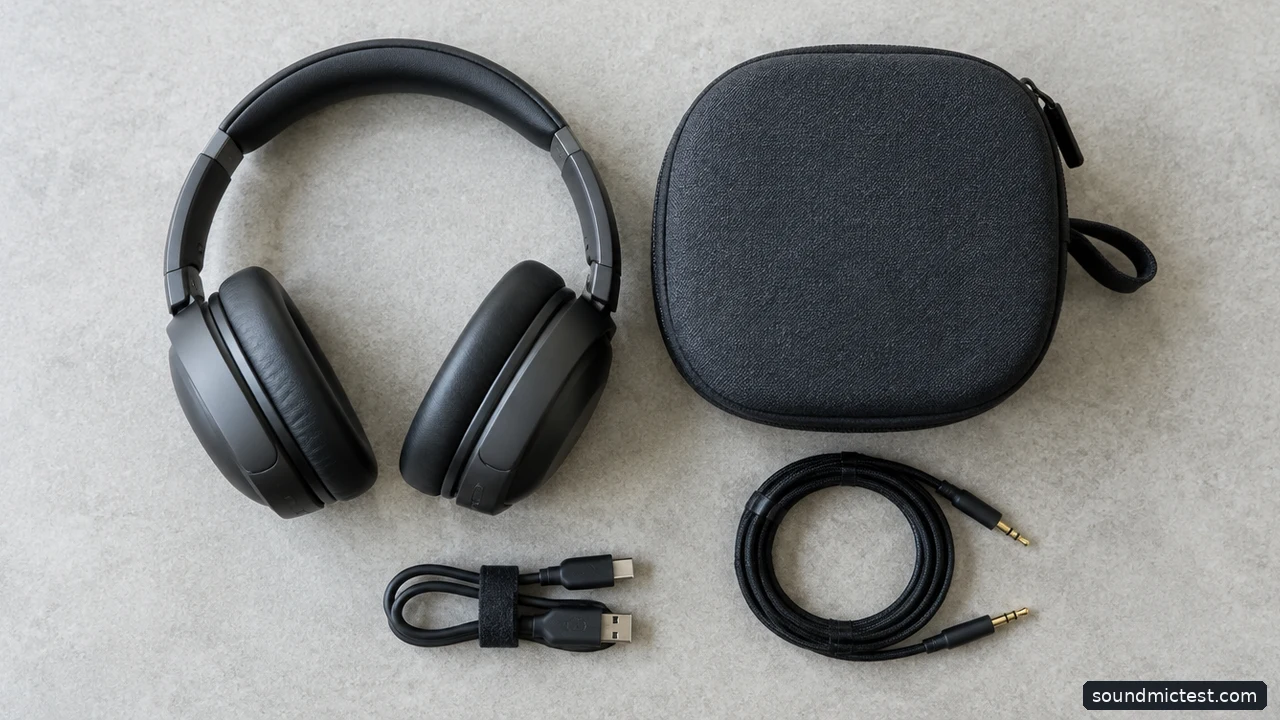
A practical case and the right cables are part of the purchase. Editorial illustration.
Music at home: the room decides whether open-back makes sense
Open-back headphones allow sound to pass through the housing. They are worth considering in a quiet private room, but not when you need to keep sound away from other people. The HD 560S is one example of this category. Sennheiser's source and amplifier guidance is a useful starting point before adding extra hardware.
A closed-back wired model such as ATH-M50x is a different practical choice. Our ATH-M50x setup guide covers cables and connection details. It does not turn closed-back construction into ANC or promise complete silence in a noisy room.
Choose the headphones before buying accessories to match an imagined setup. A working output, appropriate cable and comfortable fit may be all you need. Add an amplifier or DAC to solve a defined limitation rather than to make the desk look complete.
Earbuds: pocketability does not remove the fit question
AirPods Pro 3 is a useful candidate for compatible Apple devices, while Sony WF-1000XM6 offers another combination of wireless features. The right choice depends on your devices, the tip seal and how the controls behave in normal use.
Try more than one tip size. Check whether speaking or walking changes the fit, and test calls on the device you actually use. A large battery total that includes case recharges should not be confused with the length of a single listening session.
If you dislike anything sealing the ear canal, investigate a different physical design instead of assuming the next premium earbud will solve the problem. Comfort is a requirement, not a bonus awarded after comparing every codec.
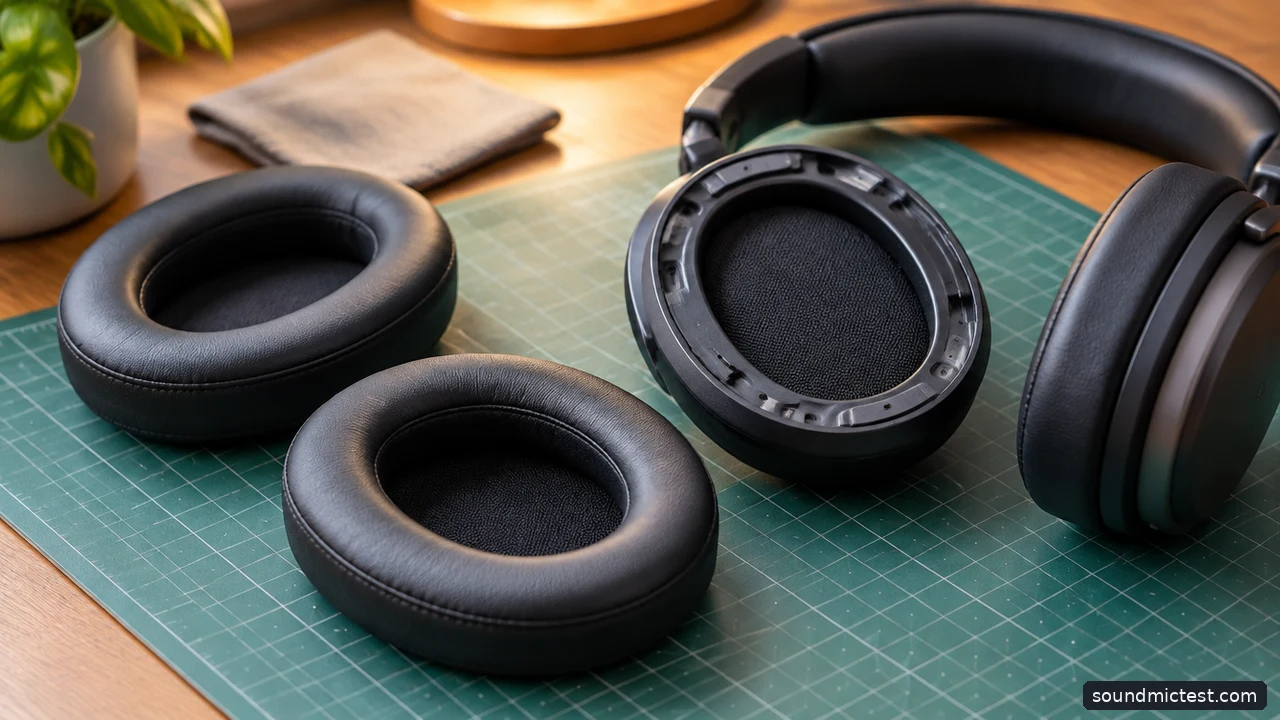
Compatible replacement parts can extend useful life. Editorial illustration.
Gaming and exercise need their own shortlist
A gaming headset should have explicit support for your platform and connection. The Arctis Nova 7 Gen 2 family is an example to investigate when mixed game-and-phone audio is important. Check the exact variant before buying.
Exercise introduces a different problem: stability through movement. The Powerbeats Pro 2 fitting guide explains an earhook approach, while OpenRun Pro 2 uses an open-ear sports format. Neither shape is automatically right for every ear, activity or pair of glasses.
Keep maintenance in the budget too. Replacement cushions, ear tips, cables and receivers affect how long the purchase remains useful. Confirm that suitable parts are available before choosing an unusually cheap model with uncertain support.
Finish with a setup check
Before returning a pair for an apparent fault, confirm the selected audio device and balance settings. Our stereo test checks left and right playback, and the microphone test can help identify an input-selection problem. These are functional checks, not laboratory ratings.
The strongest buying decision is specific: the right design for your room or journey, the right connection for your devices and a fit you can tolerate for the full session. Once those are settled, extra features become much easier to judge.