Headphones and earbuds
Best Running Headphones for Secure Fit and Outdoor Awareness
Running headphones need to stay in place when your pace changes, keep their controls usable and suit the route in front of you. A pair that sounds appealing on a sofa can become distracting once a cable bounces, a touch control registers sweat or a headband competes with your sunglasses.

Noah Mitchell is an editorial pen name for wireless audio and accessories at Sound Mic Test. Articles explore earbuds, portable audio, cables and the small setup choices that affect everyday listening.
Sound Mic Test editorial pen name.
noah.mitchell@soundmictest.com
Running headphones need to stay in place when your pace changes, keep their controls usable and suit the route in front of you. A pair that sounds appealing on a sofa can become distracting once a cable bounces, a touch control registers sweat or a headband competes with your sunglasses.
For outdoor running, an open-ear design is a sensible starting point because it leaves the ear canal unobstructed. For treadmill sessions, sealed earbuds with secure hooks may be more useful. Neither design guarantees awareness or safety: listening volume, traffic, wind and your own attention still matter. The following shortlist is based on documented features and fit arrangements, not a claimed race-distance test.
Three designs worth comparing
| Design | Example | Main advantage | Main compromise |
|---|---|---|---|
| Connected open-ear band | Shokz OpenRun Pro 2 | One-piece fit without sealing the ears | Rear band can conflict with clothing |
| Separate open-ear hooks | Shokz OpenFit 2 | No connecting band behind the head | Two earbuds and a charging case to manage |
| Sealed sport earhooks | Beats Powerbeats Pro 2 | Secure outer hook with a sealing tip | More separation from surrounding sound |
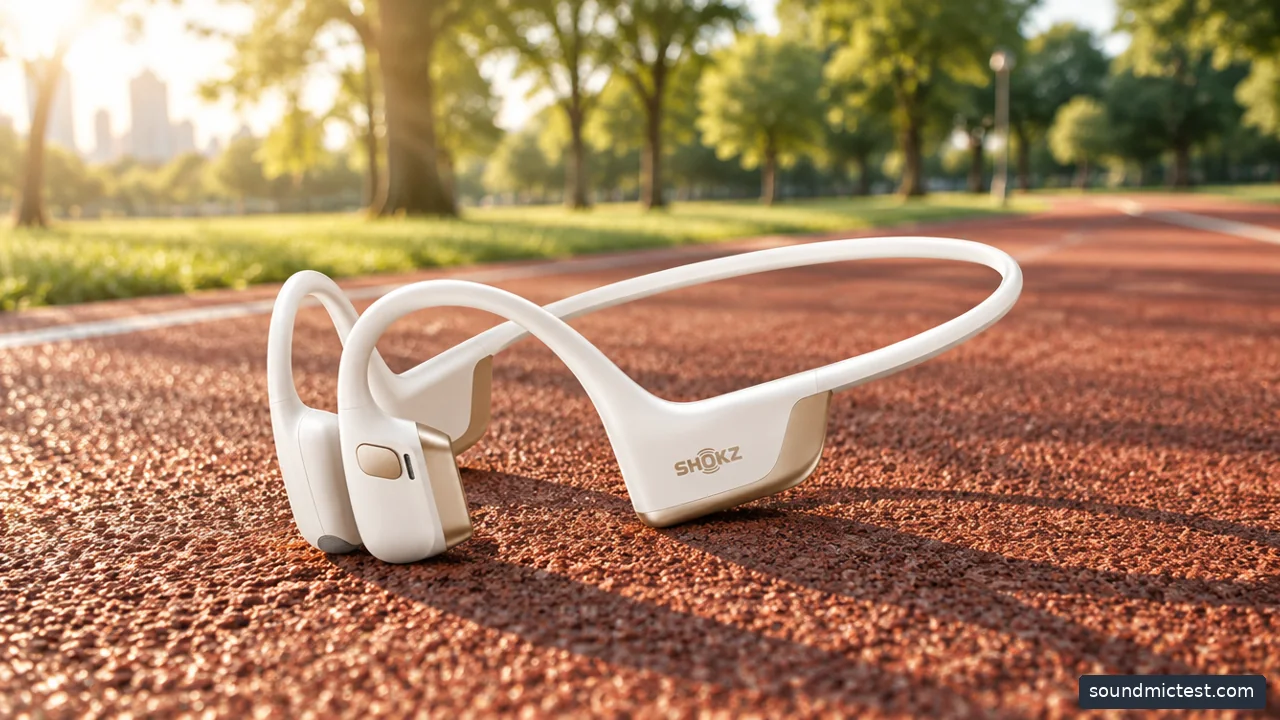
A connected open-ear sports design leaves the ear canal open; fit still depends on head size. Editorial illustration.
OpenRun Pro 2 for an unobstructed ear canal
Shokz OpenRun Pro 2 combines bone and air conduction in a connected sports headset. Shokz offers two band sizes and rates it IP55. That is a reason to consider it for sweat and everyday outdoor use, not permission to swim with it.
The connected design solves a specific nuisance: there is no loose charging case to juggle when you briefly remove the headset. The rear band, however, needs space. Try it with your usual cap, glasses and jacket collar. A fit that works in a T-shirt may feel different once a winter collar pushes against the band.
Its open construction also has an obvious limit. Wind and busy surroundings can mask quieter parts of a podcast. Turning the volume up until everything disappears defeats much of the reason for choosing an open-ear design. If the route is too noisy for comfortable listening, pause playback instead of treating output power as the solution.
OpenFit 2 when a rear band gets in the way
The OpenFit 2 series puts each speaker on its own earhook. Physical buttons are a useful feature to compare if you dislike tapping touch surfaces during exercise. Check the exact variant: OpenFit 2 and OpenFit 2+ do not have identical charging features.
Separate hooks can be easier to combine with a high jacket collar, but the earhook and glasses arm still occupy nearby space. Try them together. Move your head gently, lean forward and check whether the speaker remains positioned consistently. A secure hook is only helpful if it also places the speaker where you can hear it without excessive volume.
Powerbeats Pro 2 for indoor training and a sealed fit
Powerbeats Pro 2 combines earhooks with silicone tips, ANC and a transparency mode. Beats specifies an IPX4 rating for the earbuds and includes several tip sizes. The appeal for a treadmill session is the combination of an outer anchor and an inner seal.
That does not make the fit universal. A hook can feel stable while the tip still loosens as your jaw moves. Compare tip sizes and practice the controls before starting a workout. Transparency is also an electronic listening mode, not the same arrangement as leaving the canal physically open. For outdoor routes, check what you can actually hear at a low playback level.
Running shoes and generic open-ear sports headset on a park bench. Editorial illustration.
A fit check before the first run
Put on the complete outfit you expect to use: sunglasses, cap and any headband. Walk around indoors, jog lightly in place, look over each shoulder and bend as if tying a shoe. Pay attention to pressure as well as movement. A product that never slips but presses painfully on the ear is not a successful fit.
Next, try pausing and changing volume without looking at a phone. Controls should be easy enough that you do not need to stop and inspect an app. If you use gloves, test those too. Consider whether an accidental press can trigger a voice assistant or switch the listening mode.
Before leaving, check both channels with the stereo test. This can catch a connection problem, but it does not measure running stability or awareness. Our broader workout headphone guide covers the choice between in-ear, open-ear and over-ear equipment.
Battery claims and wet-weather routines
Compare single-charge runtime with the length of your longest session. A case total does not help during a continuous run. Manufacturer battery figures also depend on playback settings, so leave a margin rather than planning to use the final advertised minute.
A runner standing still at a quiet park path holding earphones, no traffic. Editorial illustration.
After a wet run, follow the manufacturer's cleaning instructions and let the headset dry before charging. Keep the charging case out of a damp pocket: the earbuds' water rating does not automatically apply to the case. Do not assume that sweat resistance also covers detergents or salt water.
For most outdoor runners, start by comparing the two open-ear arrangements and choose the one that works with your clothing. For a noisy indoor gym, a sealed hook design may be more practical. Route, fit and controls should decide the shortlist before extras such as spatial audio or fitness sensors enter the conversation.