Headphones and earbuds
Best Over-Ear Workout Headphones: When Earbuds Are Not for You
Over-ear workout headphones are a niche purchase. They can suit people who dislike earbuds, but large cushions trap warmth and the headband has to remain stable through movement.

James Carter is an editorial pen name for Sound Mic Test's headphone coverage. Articles under this byline focus on comfort, isolation, connectivity and the everyday trade-offs between different headphone designs.
Sound Mic Test editorial pen name.
james.carter@soundmictest.com
Over-ear workout headphones are a niche purchase. They can suit people who dislike earbuds, but large cushions trap warmth and the headband has to remain stable through movement. A regular travel headphone is not automatically ready for sweat simply because it appears in a gym photograph.
BlueAnt Pump X is a clearer starting point because its manufacturer specifies an IP54 rating and replaceable everyday and cooling-gel pads. Some Skullcandy listings distinguish active-use variants from ordinary Crusher models, which makes exact-version checking essential. This guide focuses on documented suitability and practical fit. It does not claim that a bass-heavy headphone is inherently better for training.
What belongs on the shortlist?
| Candidate or approach | Reason to consider it | What must be checked |
|---|---|---|
| BlueAnt Pump X | Explicit sports positioning and IP54 rating | Fit, pad care and current regional model |
| Specifically identified active-use variant | May include different pad or coating features | Do not transfer claims to the standard version |
| Existing over-ear headphone for light dry activity | Avoids another purchase | Manufacturer guidance may not cover sweaty use |
| Sport earbuds or open-ear headset | Less cushion contact around the ear | Different fit and isolation trade-offs |
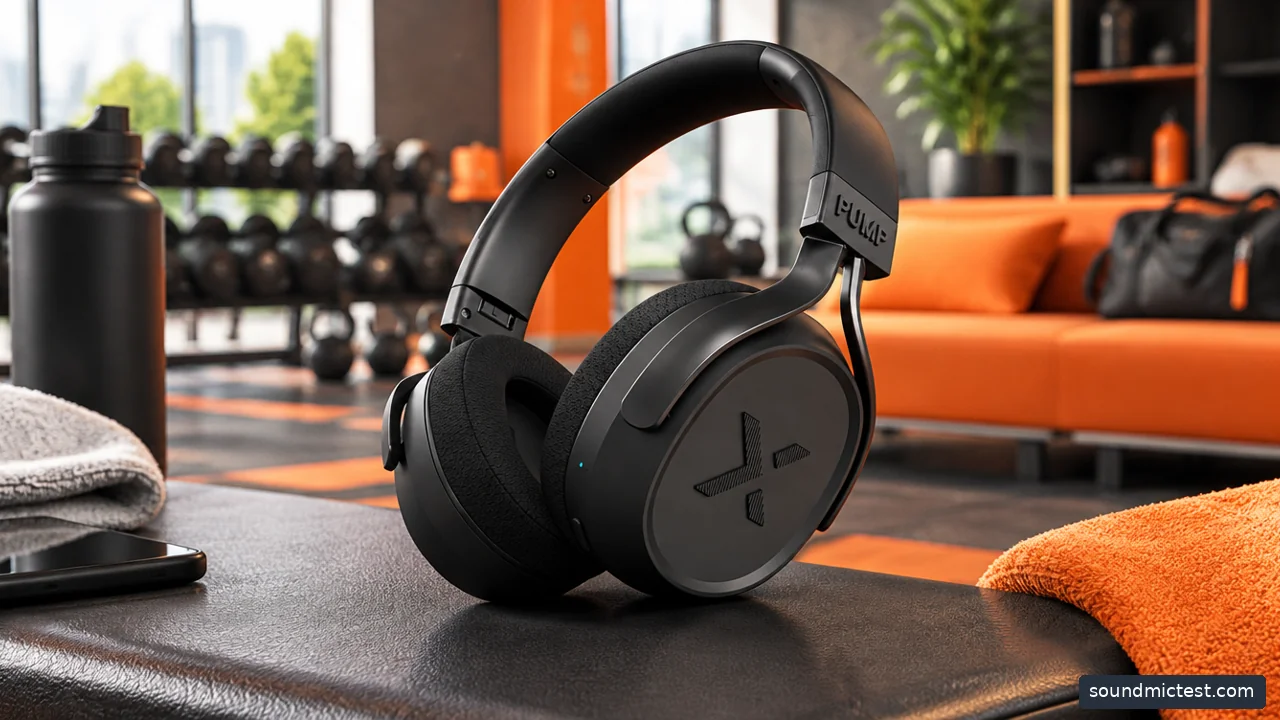
BlueAnt Pump X documents sports use and an IP54 rating; follow its pad-care guidance. Editorial illustration.
Pump X for an explicitly sport-oriented design
BlueAnt Pump X is marketed as an over-ear sports headphone with an IP54 rating and replaceable pads. That is a more useful foundation for a gym purchase than a generic claim that a headphone feels durable.
The two pad options are worth considering as part of the fit. They may change contact area and the way the headphone feels during a session. Do not assume a cooling-gel label guarantees that your ears remain cool through every workout; body heat, room temperature and exercise intensity still affect comfort.
BlueAnt's care guidance distinguishes sweat and splash resistance from waterproofing. Follow its cleaning and drying instructions rather than rinsing the headphones under a tap. A documented resistance rating reduces uncertainty, but it does not remove the need for ordinary care.
Read active-use claims at the variant level
The Crusher Evo product listing distinguishes some active-color features from the standard configuration. That is exactly the kind of detail that can disappear when a marketplace combines several colors and versions on one page.
If you are considering such a listing, confirm the exact SKU, included pads and moisture-related claims. Do not buy a standard version because a photograph or bullet point elsewhere describes an active variant. A special coating is also not automatically equivalent to a published IP rating.
Adjustable sensory bass may be enjoyable for some listeners, but it is a preference feature rather than evidence of workout suitability. The headphone still needs to fit securely, tolerate its intended environment and remain comfortable when you move.
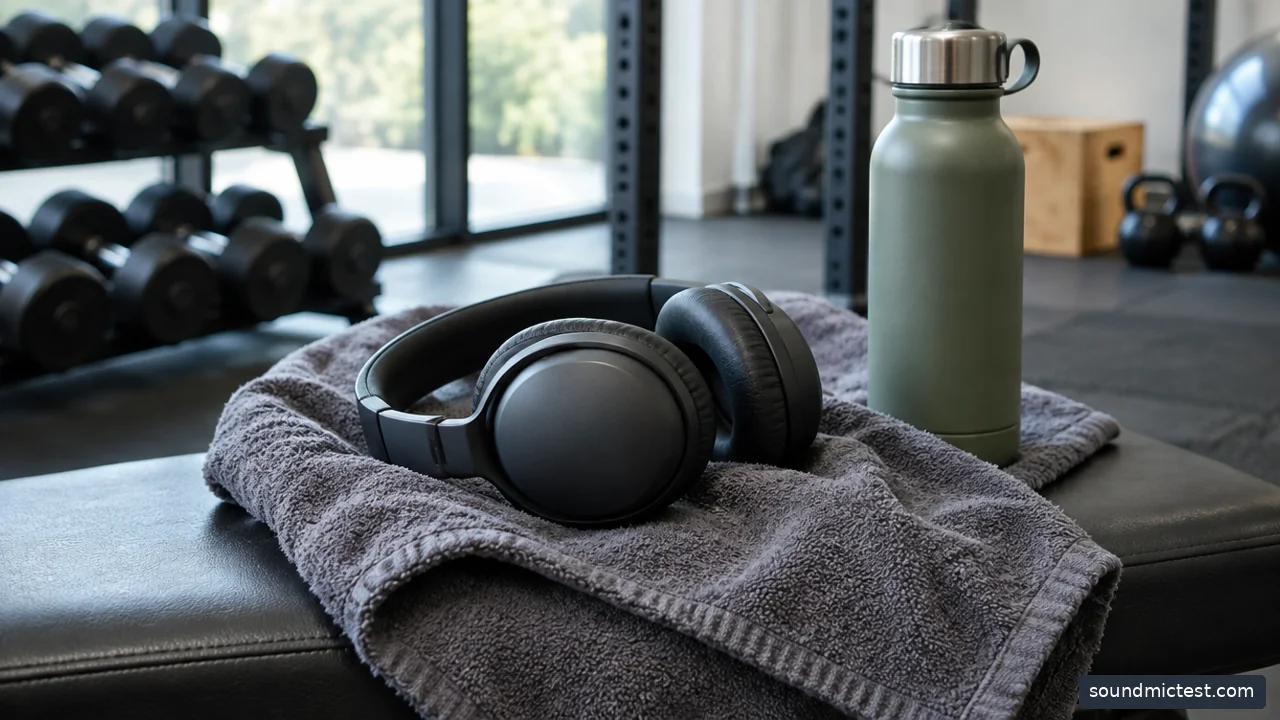
over-ear headphones on gym towel beside reusable bottle. Editorial illustration.
Match the fit test to the exercise
For strength training, check the headphone while leaning forward and resting against the type of bench you use. A headband that stays centered during walking can slide when your position changes. Ear cups can also meet a headrest and shift the seal.
For cardio, try a brief indoor movement check before committing to a long session. Notice whether you repeatedly reach up to reseat the cups. A tighter clamp may reduce movement while increasing pressure, so stability alone is not enough.
Keep cables away from equipment. A wired connection can be useful at a desk, but a dangling lead introduces another thing to catch during exercise. If wireless operation is the intended use, confirm the controls and connection before entering the training area.
Heat and cleaning are ownership costs
Large cushions contact more skin than many earbud designs. After a session, inspect them and follow the approved cleaning method. Store the headphones dry rather than immediately sealing damp pads inside a bag.
Check replacement-pad availability before buying. Worn or damaged pads can affect comfort and the acoustic seal, and a visually similar third-party pad may change both. Treat easy replacement as a useful maintenance feature rather than a reason to ignore care.
If you already own a premium ANC travel headphone, consult its manual before using it for sweaty workouts. An expensive product may still lack a suitable resistance specification. It can be more economical to keep that pair for travel and choose a different design for exercise.
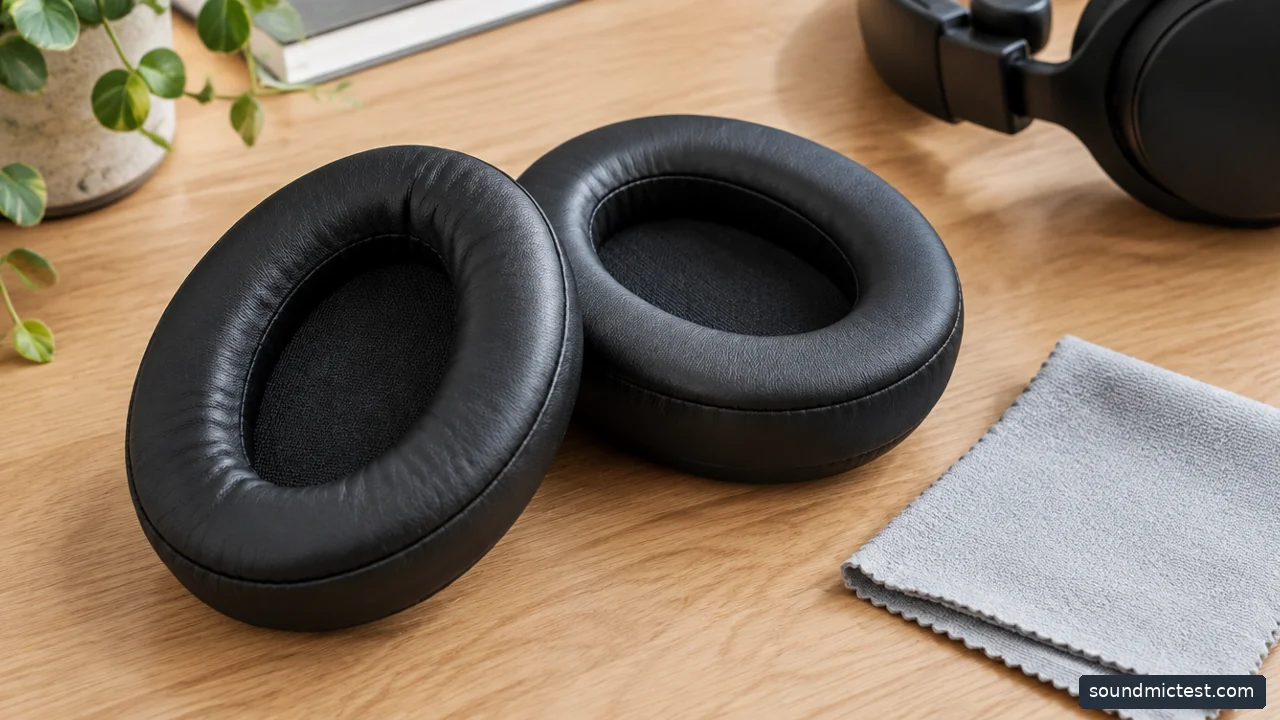
Close view of detachable headphone cushions beside a clean microfiber cloth. Editorial illustration.
Consider whether over-ear is solving the right problem
If the reason you dislike earbuds is a sealed canal, an open-ear hook or connected sports headset may solve the problem with less cushion contact. If the issue is loose fit, a sport earhook may be enough. Our workout-earbud guide covers those alternatives.
For ordinary playback checks, use the stereo test before the session. It cannot validate sweat resistance or stability. Keep listening at a comfortable level and pause when you need to hear instructions or surrounding activity.
Start with a model that explicitly documents its intended sports use, then test it against your actual movements. Pump X is a concrete candidate to investigate; active variants elsewhere require careful identification. Do not turn a preference for strong bass or a large ear cup into an assumption that every over-ear headphone belongs in the gym.