Headphones and earbuds
Best IEMs for Music: A Guide to Fit, Tuning and Value
The best IEM for music is the one whose fit, tuning and connection suit your listening habits. Driver count and a dramatic frequency-range claim are poor substitutes for those basics.

James Carter is an editorial pen name for Sound Mic Test's headphone coverage. Articles under this byline focus on comfort, isolation, connectivity and the everyday trade-offs between different headphone designs.
Sound Mic Test editorial pen name.
james.carter@soundmictest.com
The best IEM for music is the one whose fit, tuning and connection suit your listening habits. Driver count and a dramatic frequency-range claim are poor substitutes for those basics. A modest pair with a comfortable seal can be more useful than a costly model you keep adjusting or cannot connect conveniently.
Moondrop CHU II, FiiO JD1 and Sennheiser IE 200 illustrate three sensible starting points: a replaceable-cable analog model, a family with analog and USB-C options, and a more expensive compact design. These recommendations use manufacturer documentation and practical system requirements. They do not turn published specifications into a claimed listening test.
Pick the connection before chasing specifications
| Model | Main practical appeal | What to check |
|---|---|---|
| Moondrop CHU II | Replaceable cable and filters | Standard analog versus separately sold DSP variants |
| FiiO JD1 | Choice of analog or USB-C model | Exact plug and cable features |
| Sennheiser IE 200 | Compact design and tip-position adjustment | Cable system and total source cost |
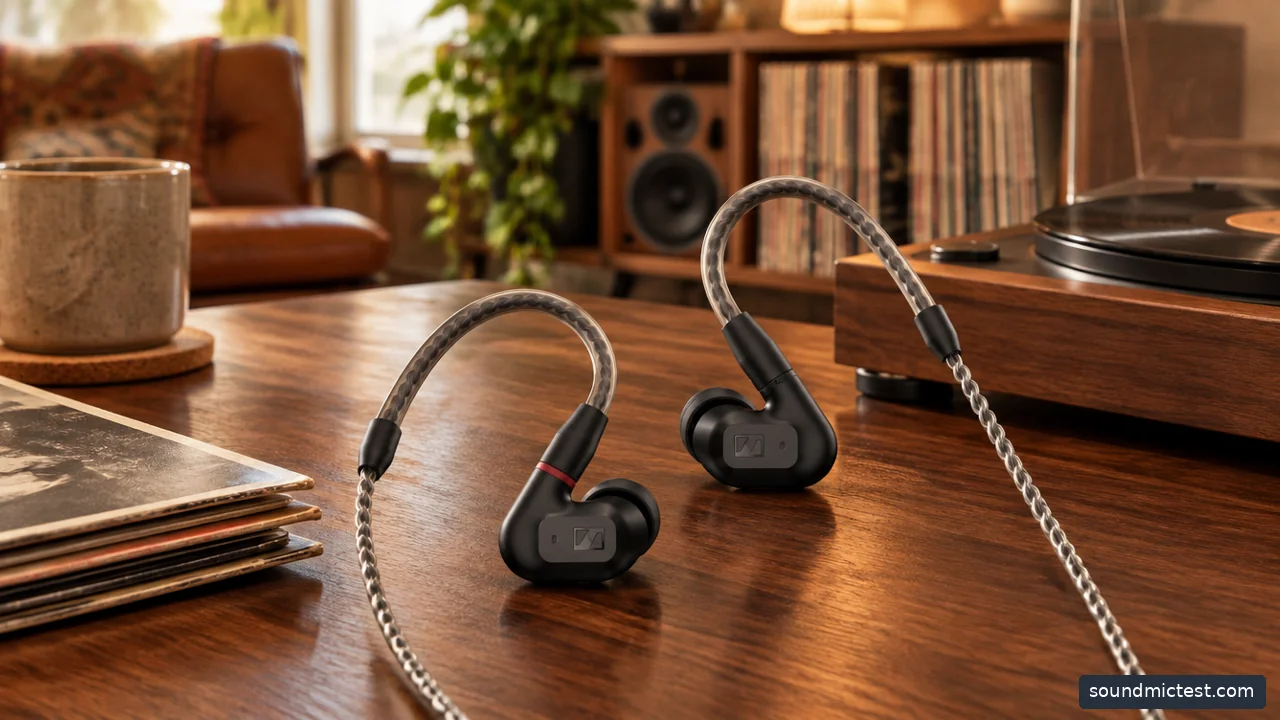
Replaceable tips and a compatible source are central to a useful IEM setup. Editorial illustration.
CHU II for a serviceable analog starting point
Moondrop's CHU II combines a metal shell, detachable cable and replaceable acoustic filters. Those are useful ownership details when you want an IEM that can be maintained instead of discarded after a cable problem.
The filter system is not an invitation to modify the earphone without guidance. Follow the manufacturer's procedure and use appropriate replacements. A blocked filter can affect playback, but replacing parts at random can create a different imbalance or damage a small component.
Its standard 3.5mm connection works with a suitable analog output. If your phone has only USB-C, include a compatible DAC adapter in the budget or compare a digital version explicitly. Do not assume that a product photograph showing the same shell establishes the same cable and tuning configuration.
JD1 for a source-led choice
The FiiO JD1 range includes the USB-C JD1 TC and an analog JD1. The digital version places conversion electronics in the connection, while the analog version relies on the source's headphone output.
That distinction is more useful than choosing from the largest supported sample rate. A higher number does not by itself establish better music reproduction. The recording, output behavior, ear-tip seal and listening level all contribute to the experience.
Choose the version that reduces friction in your everyday setup. A direct USB-C connection may be convenient for one phone, while an analog cable may be easier to move between a music player and an interface. Verify microphone functions separately if you also want calls.
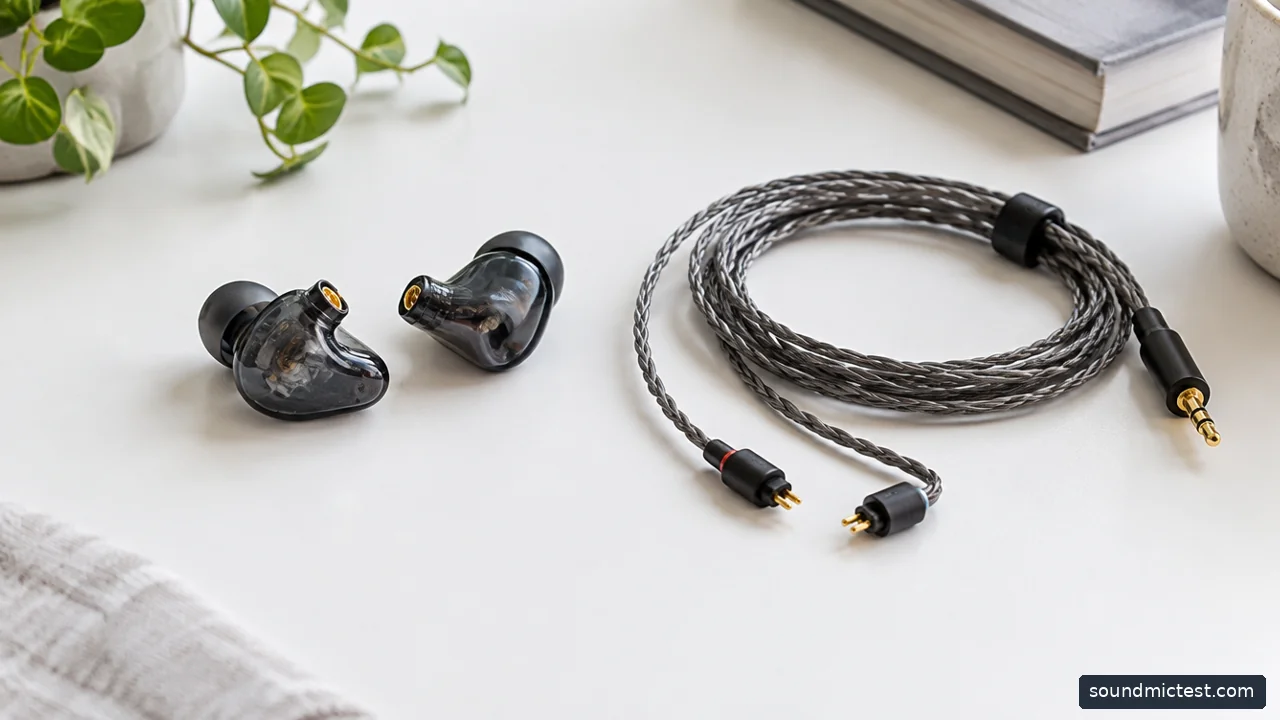
in-ear monitors with detachable cable laid separately on white desk. Editorial illustration.
IE 200 when the fit is worth paying for
The Sennheiser IE 200 has a compact shell and a removable cable. Its supplied tip arrangement allows two positions that alter low-frequency behavior. Try the intended positions according to the documentation rather than assuming one setting is objectively correct.
The important purchase question is whether the fit and ownership arrangement improve your routine enough to justify the price. A familiar brand and a more expensive cable system do not establish a universal sound-quality advantage for every listener.
Check replacement-cable compatibility carefully. A connector family name is not always enough to guarantee that a third-party housing seats properly. If serviceability is a reason for spending more, confirm that the parts you may need are available through a reliable source.
Seal first, tuning second
Before judging bass or vocal balance, make sure both ears have a comfortable seal. Try the supplied sizes and compare each side independently. If one ear sounds thin, reseat it gently and inspect the tip rather than immediately reaching for an EQ slider.
Foam and silicone tips can feel different and may change the listening result. Neither material is automatically superior. Consider comfort, maintenance and the way the tip fits the nozzle. A loose aftermarket tip is not a worthwhile upgrade just because it receives enthusiastic comments online.
Once the fit is stable, use familiar music at a comfortable level. Notice whether voices remain easy to follow, whether bass dominates the arrangement and whether treble becomes tiring. These are preference questions to investigate, not a checklist that proves one universal tuning target.
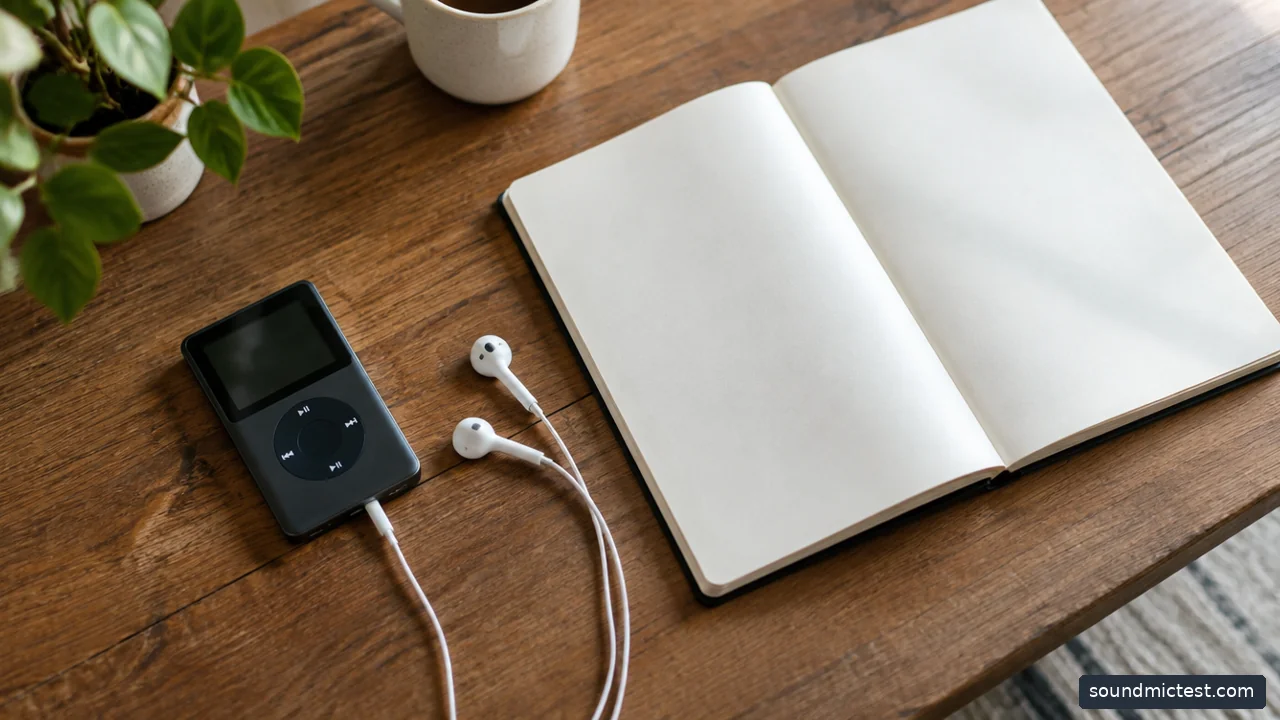
Music player and wired earphones beside an open unmarked notebook. Editorial illustration.
Do you need another DAC or amplifier?
Begin with the source you own. If it provides enough clean volume, useful adjustment range and no distracting noise, another device may not solve a practical problem. If it hisses audibly or cannot drive the earphones comfortably, investigate the output rather than assuming every IEM needs an expensive amplifier.
Compare sensitivity specifications carefully because manufacturers may use different units. An impedance figure alone is not a complete description of the load or required output. Avoid converting a few numbers into a guaranteed performance prediction without the relevant conditions.
The stereo test helps confirm channel orientation and basic playback after changing cables. It does not measure frequency response or prove that a DAC improves detail. Our wired-headphone guide covers the broader source and socket decision.
Start with the connection that fits your equipment, then prioritize a comfortable seal and a tuning you enjoy. CHU II and JD1 are useful entry points for different source arrangements; IE 200 belongs on the shortlist when its fit and cable system justify the extra expense. Buy the complete listening experience rather than a collection of impressive numbers.