Headphones and earbuds
Best Over-Ear Headphones for Comfort and Everyday Use
Comfortable over-ear headphones need to fit the way you sit, travel and wear glasses. A low weight helps, but it cannot tell you whether the cushions touch your ears, the headband creates a pressure point or the cups become warm after an hour.

James Carter is an editorial pen name for Sound Mic Test's headphone coverage. Articles under this byline focus on comfort, isolation, connectivity and the everyday trade-offs between different headphone designs.
Sound Mic Test editorial pen name.
james.carter@soundmictest.com
Comfortable over-ear headphones need to fit the way you sit, travel and wear glasses. A low weight helps, but it cannot tell you whether the cushions touch your ears, the headband creates a pressure point or the cups become warm after an hour. The best choice is therefore a fit shortlist, followed by a practical trial.
For everyday wireless use, compare Sennheiser Momentum 4 and Sony WH-1000XM6. For a quiet home desk, an open-back model such as Sennheiser HD 560S changes the comfort and isolation equation. These suggestions draw on documented design and features. Comfort remains personal, and no manufacturer description can replace trying the headphones with your own head shape and glasses.
Choose the environment first
| Where you listen | Useful design | Main compromise |
|---|---|---|
| Commute and shared office | Closed wireless headphone with ANC | Heat, charging and electronic controls |
| Quiet private room | Open-back wired headphone | Sound leakage and audible surroundings |
| Regular calls | Convenient microphone and mute controls | Call quality still depends on the connection |
| Long travel days | Manageable case and battery margin | A larger case can dominate a small bag |
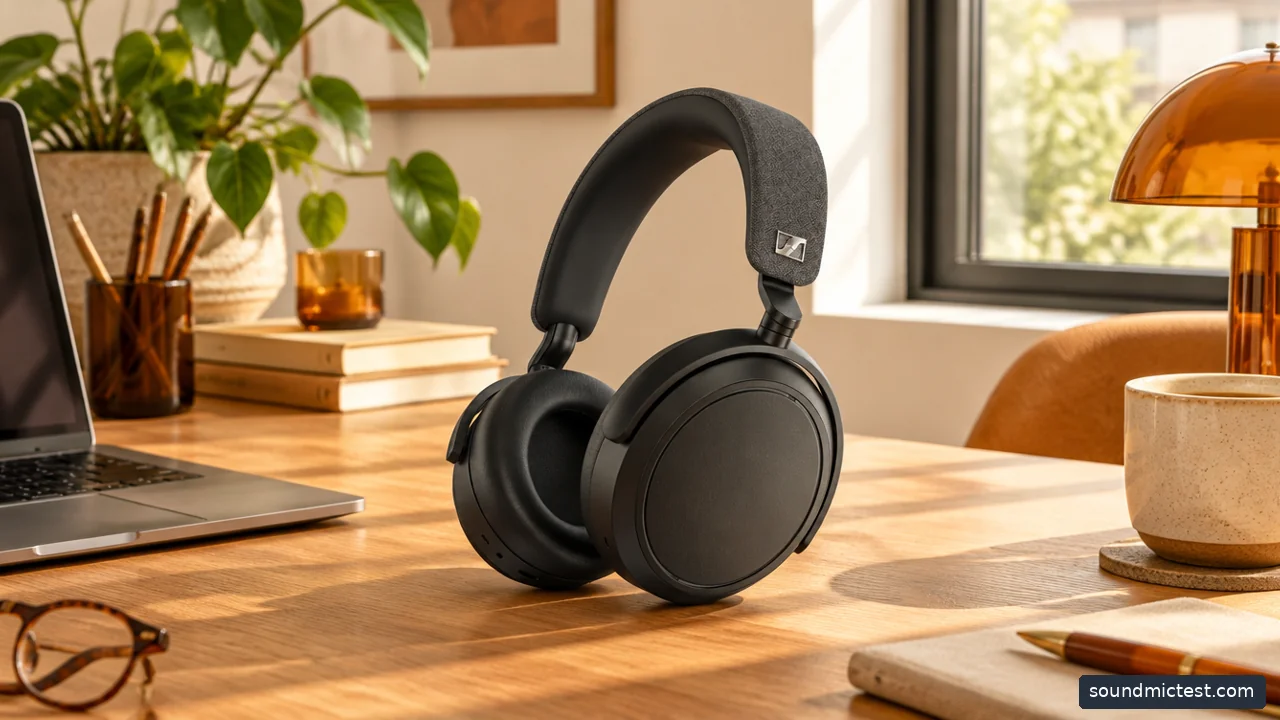
Cushion size, clamp and glasses can change the comfort of an over-ear headphone. Editorial illustration.
Momentum 4 for a mixed home-and-travel routine
Sennheiser Momentum 4 combines padded over-ear cups, adaptive noise cancellation and sound customization through its app. Its manufacturer-rated battery life is a reason to consider it if frequent charging irritates you, although actual runtime depends on settings and use.
The important comfort check is how the headband and cushions distribute pressure. Extend the band enough that the cups sit around the ears rather than pulling upward against them. Then check the seal with your normal glasses. Thick temples can change both pressure and the way the pads contact your head.
Touch controls also deserve a trial. If you habitually adjust the right cup, see whether that movement triggers unwanted commands. A comfortable cushion cannot compensate for controls you repeatedly activate by accident. Our Momentum 4 setup guide is useful once you have chosen that model.
Sony WH-1000XM6 for a flexible everyday connection
Sony's WH-1000XM6 specification sheet confirms multipoint, an analog headphone input and passive operation. Those options can be useful when a working day moves between a phone, a laptop and a wired source.
Do not translate flexibility into guaranteed comfort. Check cup depth, headband contact and the effect of your glasses just as you would with the Sennheiser. Also try the headphones while looking down at a laptop. Pressure distribution can change when your posture changes, particularly if you lean forward for long periods.
An analog connection is useful as a fallback, but it is not a promise that every wireless function survives. Follow the manual for microphone behavior and powered versus passive listening. The complete connection path matters more than the presence of a cable in the box.
HD 560S when the room is quiet
The HD 560S is a wired open-back option with fabric-covered pads. Its ventilated construction makes it a different proposition from a sealed travel headphone. It is worth considering for a private desk where you do not need to block surrounding conversation.
The compromise is unavoidable: sound can escape, and room noise can reach you. It is not the right substitute for ANC on a train. If you share a bedroom or office, check whether the leakage is acceptable before deciding that an open design is the more comfortable choice overall.
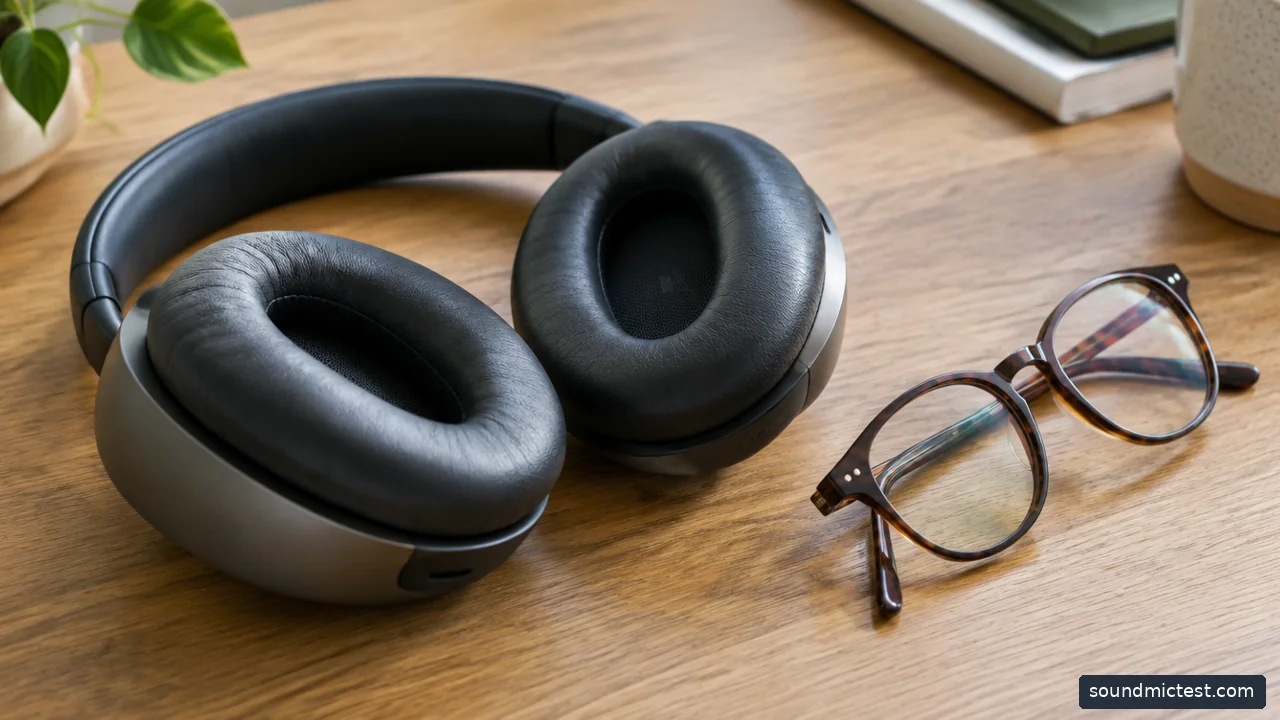
Close view of generic headphone cushions beside eyeglasses on oak desk. Editorial illustration.
A useful comfort trial takes more than a minute
Begin with the headband loose enough to position the cups naturally. Wear the headphones for a normal short work session, then notice where you feel pressure. Is it the top of the head, the jaw, the glasses arms or the edge of the ear? Those observations help distinguish a fit problem from an adjustment problem.
Remove the headphones if they become painful rather than trying to endure the fit. Avoid bending the headband aggressively to reduce clamp; that can damage the structure and create a different problem. If the design is wrong for you, a return within the seller's policy is more useful than a risky modification.
Consider replacement cushions as part of ownership. Pads wear, and changing their thickness or material can alter both fit and sound. Check the availability of appropriate replacements rather than assuming any pad with a similar outline will perform identically.
Everyday usability can outweigh an extra feature
Look at the case, charging lead and storage position. A headphone that is comfortable to wear but awkward to pack may stay at home when you need it. If you switch between speakers and headphones, check how easily your computer changes outputs and whether calls select the intended microphone.
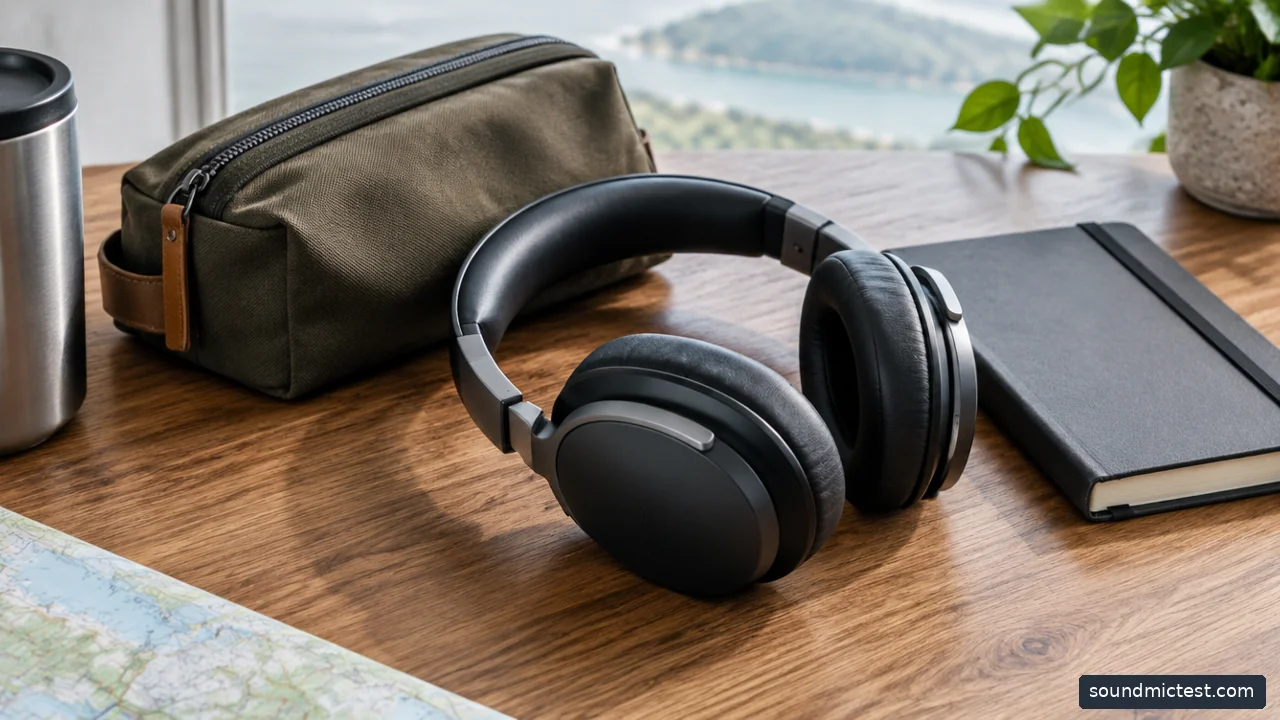
Headphones resting beside a travel pouch and closed notebook. Editorial illustration.
The stereo test can confirm correct playback after pairing or reconnecting. It does not measure comfort or noise cancellation. Use familiar music at a moderate level while making your decision, and avoid comparing one headphone much louder than another.
For mixed travel and desk use, start with the two closed wireless options and let fit decide. For a quiet private room, add the HD 560S to the comparison. A comfortable headphone is one you can use naturally through your normal routine, with controls and storage that demand little attention.