Headphones and earbuds
Best Open-Ear Earbuds for Comfort and Awareness
Open-ear earbuds are worth considering when you dislike silicone tips sealing the ear canal or want background sounds to remain accessible. They are a different listening arrangement, not simply noise-canceling earbuds with one feature removed.

Noah Mitchell is an editorial pen name for wireless audio and accessories at Sound Mic Test. Articles explore earbuds, portable audio, cables and the small setup choices that affect everyday listening.
Sound Mic Test editorial pen name.
noah.mitchell@soundmictest.com
Open-ear earbuds are worth considering when you dislike silicone tips sealing the ear canal or want background sounds to remain accessible. They are a different listening arrangement, not simply noise-canceling earbuds with one feature removed. The room becomes part of what you hear, which can be useful at a desk and frustrating beside loud traffic.
Start with separate hook-style earbuds such as Shokz OpenFit 2 if you want a conventional charging-case routine. Consider a connected design such as OpenRun Pro 2 if keeping both sides together matters more. An open-fit wired earbud offers a cheaper, simpler alternative for compatible devices. This guide compares the designs and documented features without claiming a measured awareness ranking.
Open-ear does not describe one construction
| Arrangement | Example | Reason to consider it | Main limitation |
|---|---|---|---|
| Separate speaker hooks | Shokz OpenFit 2 | No sealed tip or rear connecting band | Speaker position depends on ear shape |
| Connected sports band | Shokz OpenRun Pro 2 | One-piece handling | Band can meet a collar or headrest |
| Open-fit wired shell | Apple EarPods USB-C | No charging routine | Fixed shell shape and a cable |
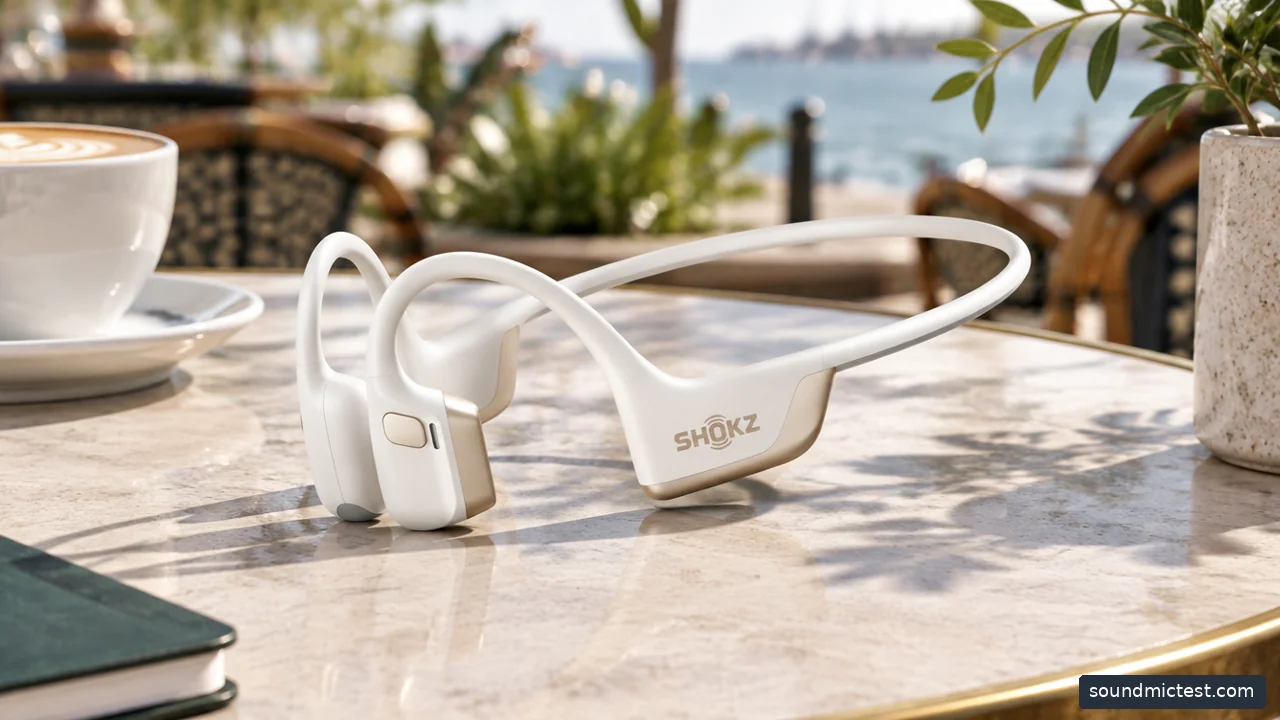
Connected open-ear headsets and separate ear hooks solve different fit problems. Editorial illustration.
OpenFit 2 for an everyday hook design
The OpenFit 2 range uses speakers positioned beside the canal and hooks around the ears. Physical buttons provide a distinct control method compared with touch-only earbuds. The separate left and right units avoid a band across the back of the head.
Fit still matters even without an ear tip. Check how the speaker sits relative to your ear and whether the hook competes with glasses. A small change in position can affect how clearly you hear at a comfortable level. An earbud that feels secure but leaves the speaker poorly positioned is not the right fit.
There is also the usual true-wireless routine: carry the case, keep the contacts clean and remember where you place each earbud. If you frequently remove them during conversations, establish a consistent storage habit rather than putting one loose in a pocket.
OpenRun Pro 2 when keeping the pair together helps
OpenRun Pro 2 is a connected open-ear headset using both bone and air conduction. It is not a pair of independent earbuds, but it belongs in the comparison because it solves the same desire for an unobstructed canal in a different way.
The band can be convenient for walks and exercise. It can also conflict with a tall collar, a high-backed chair or a pillow. Try the position you actually use rather than assuming a sports-oriented fit will work at every desk. Check the available sizing information before ordering.
For outdoor training, our running-headphone guide focuses on clothing, controls and route conditions. Keeping the canal open does not ensure that you will notice every sound around you. Playback level and attention remain important.
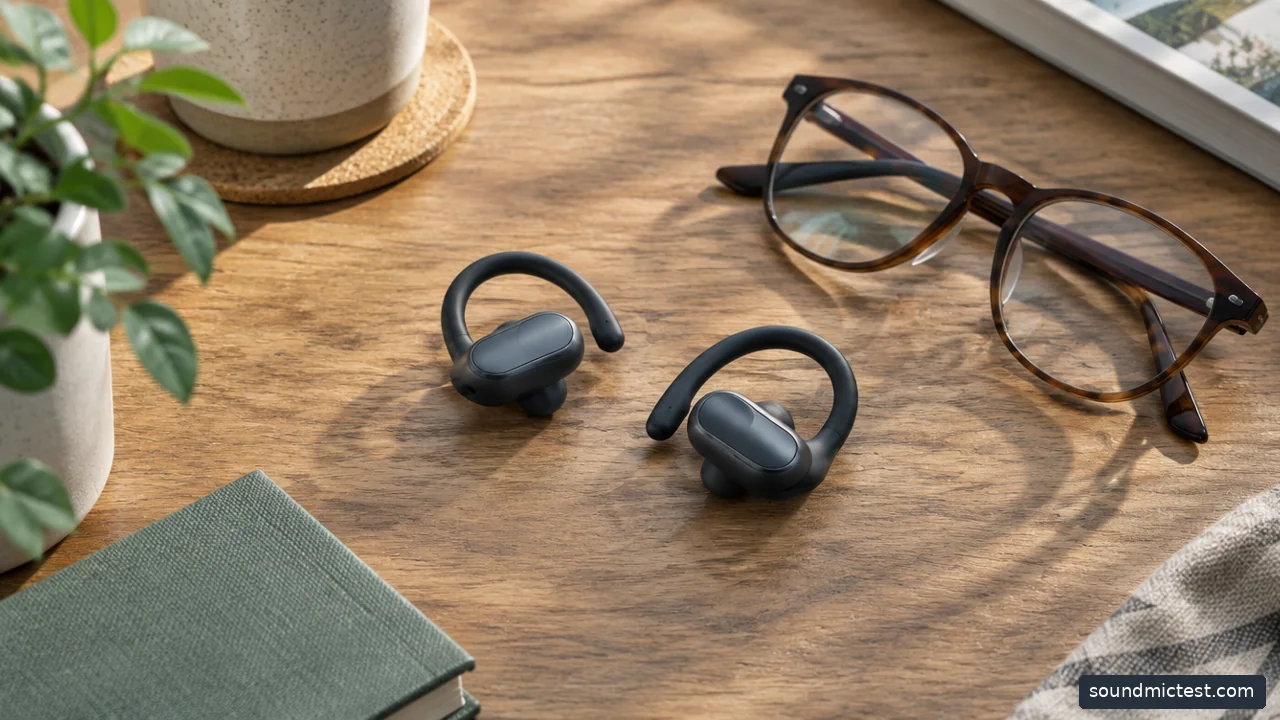
open-ear hook earbuds beside a pair of glasses on table. Editorial illustration.
EarPods as a simple open-fit alternative
USB-C EarPods do not use interchangeable sealing tips. Their shape rests at the ear entrance, which may suit people who dislike deeper in-ear designs. They also avoid a separate charging schedule.
The fixed shell is the weakness as well as the appeal. If it does not sit securely, there is little adjustment available compared with a set of tips. The cable can also catch on clothing or limit how far you move from a laptop. Check device compatibility and remote functions before treating them as a universal USB-C accessory.
This is a useful option for a quiet workspace where you want occasional calls and light listening. It is less convincing as a replacement for a secure sports hook or for isolation during a noisy commute.
Understand the limits before replacing ANC earbuds
Open-ear designs allow surrounding sound to reach you, but they cannot choose which sounds are helpful. A colleague's voice, an air conditioner and construction noise can all compete with the same podcast. If you buy primarily for trains or aircraft, a sealed ANC model may fit the job better.
Sound leakage is another variable. Ask someone nearby whether your playback is audible at your normal level, especially in a quiet office. Do not assume that a tiny speaker is automatically private. The answer depends on volume, fit and the surrounding noise floor.
Calls also deserve their own check. A design that leaves the ear comfortable does not necessarily reject wind or nearby conversation well. Use the microphone test to verify the input, then make a call through the software you normally use.

A person working at a home desk with unobstructed ears and open-ear headset. Editorial illustration.
A practical trial for comfort and usefulness
Wear the product with your usual glasses for a short work session. Turn your head, look down and remove it a few times. Check whether controls are easy to locate and whether the earhook begins to press after the initial novelty has passed.
Then try the same spoken recording in a quiet room and in your normal environment, keeping volume moderate. This will reveal whether the open design actually serves your routine. It is a more useful decision exercise than comparing maximum output claims.
Choose separate hooks for an everyday case-based routine, a connected band for one-piece handling, or open-fit wired earbuds for a simple compatible-device setup. Keep a sealed pair in consideration if noise reduction is the real priority. Open-ear listening works best when you welcome the surrounding room rather than expect the headphones to remove it.