Headphones and earbuds
Best Sleep Earbuds: Masking Noise Without Bulky Headphones
Sleep earbuds should be judged by the entire bedtime routine: how they feel against a pillow, what they play without a phone, how long that mode lasts and whether the alarm behaves as expected. A tiny shell and a large case-runtime number are not enough to establish that a pair will work through the night.

Noah Mitchell is an editorial pen name for wireless audio and accessories at Sound Mic Test. Articles explore earbuds, portable audio, cables and the small setup choices that affect everyday listening.
Sound Mic Test editorial pen name.
noah.mitchell@soundmictest.com
Sleep earbuds should be judged by the entire bedtime routine: how they feel against a pillow, what they play without a phone, how long that mode lasts and whether the alarm behaves as expected. A tiny shell and a large case-runtime number are not enough to establish that a pair will work through the night.
Soundcore Sleep A20 is a useful starting point for passive blocking and masking. The Sleep A30 family adds a different noise-control approach, while ordinary daytime earbuds are a less specialized alternative that needs careful fit checking. This guide focuses on documented functions and practical selection, without claiming medical sleep improvements or an overnight comfort test that did not happen.
Choose the routine, then the model
| Priority | What to investigate | What not to assume |
|---|---|---|
| Local masking sounds | Sleep-mode playback | Your entire streaming library works offline |
| Bluetooth bedtime listening | Streaming-mode runtime | Sleep-mode battery figure applies unchanged |
| Side sleeping | Low profile and suitable tips | Small weight guarantees comfortable pillow pressure |
| ANC | Exact active-cancellation model | Every sleep earbud includes ANC |
| Private wake-up alarm | Supported alarm behavior | It replaces every important external alert |
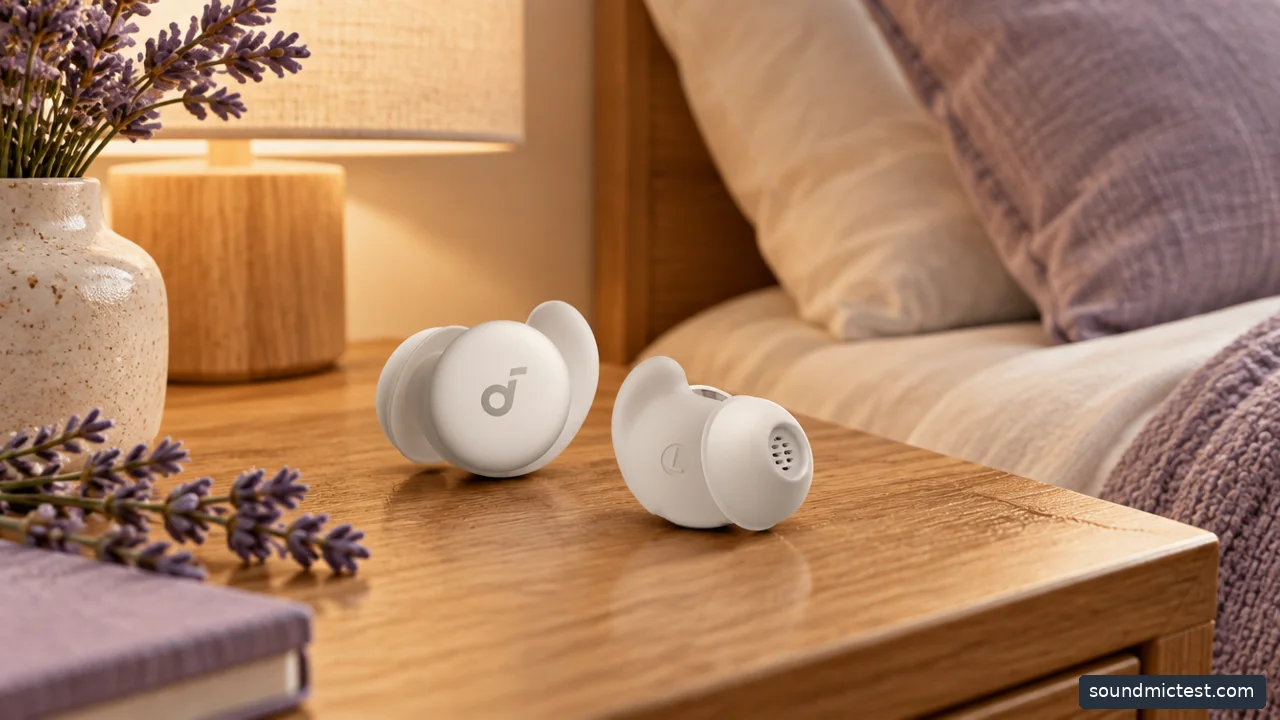
A low-profile sleep earbud still needs a comfortable seal when lying on your side. Editorial illustration.
Sleep A20 for a masking-focused setup
Soundcore Sleep A20 separates Sleep mode from Bluetooth playback. Its published battery claims differ between those modes, which is a more useful buying detail than the combined case total.
The model uses passive blocking and sound masking rather than ANC. That can still be a valid approach if your aim is a comfortable personal soundscape, but the distinction should be clear before purchase. Masking plays another sound; it does not mean the external disturbance has physically disappeared.
Investigate how sounds are selected and transferred, how the earbuds change modes and whether the phone must remain nearby for your preferred routine. Setting this up during the day is less frustrating than discovering an unexpected connection requirement after turning out the light.
Sleep A30 when active noise control is a requirement
Soundcore's current comparison guidance distinguishes the A30 family and newer models from A20. Check the exact model and regional package, including any special-edition features.
If active cancellation matters, compare the runtime and behavior with that function enabled. A manufacturer may publish several battery numbers for different modes. Choose the one that matches your intended use and leave a margin instead of planning a night around the maximum figure.
Our sleep ANC guide explains the distinction between active cancellation, a physical seal and masking. Do not buy a higher model solely because its name sounds newer if the additional function does not address your particular disturbance.
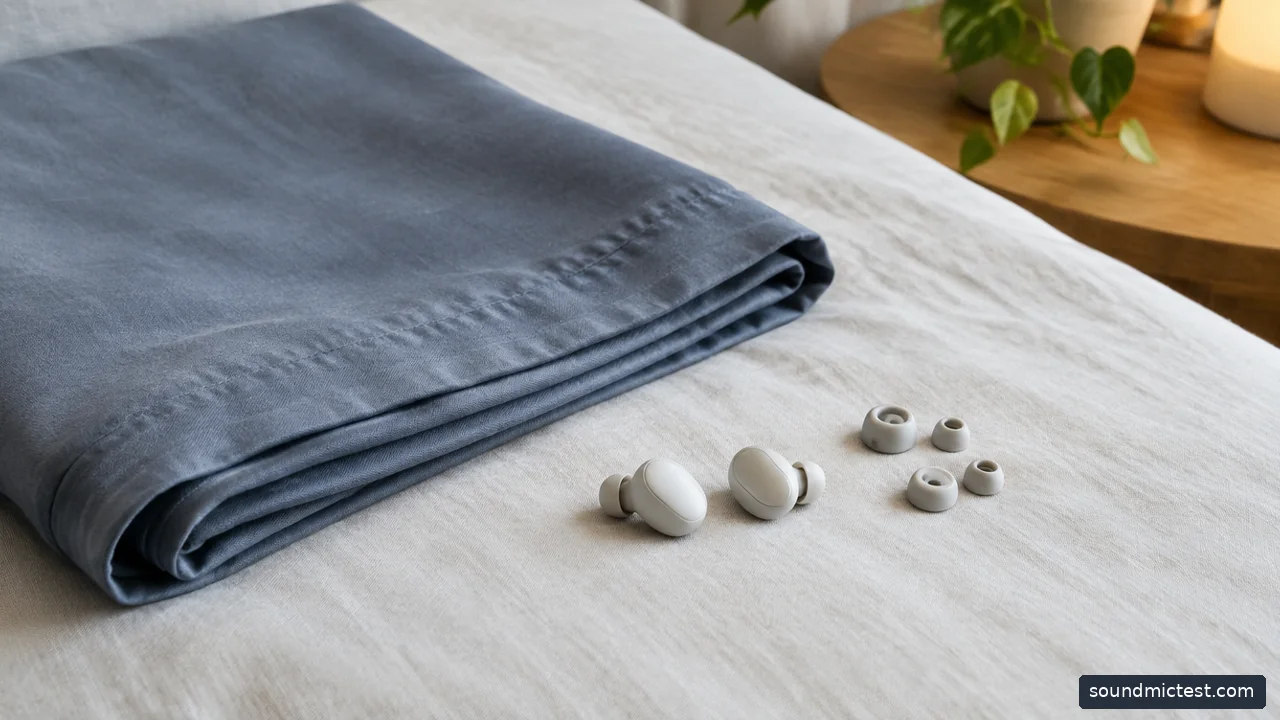
Small sleep earbuds and soft tips arranged beside folded pillowcase. Editorial illustration.
Ordinary earbuds are not automatically a sleep substitute
If you already own wireless earbuds, it is reasonable to inspect whether they meet the practical requirements before buying another pair. But a stem or protruding shell can press against a pillow, and touch controls can respond when you turn your head.
Try the position while awake and stop if it becomes uncomfortable. Do not force a larger tip or shell into place to prevent movement. The fit that works during a commute may be wrong for lying on one side.
Also check what happens when a call arrives, the battery runs low or the phone loses its connection. A daytime product may interrupt playback in ways that are unimportant on a walk and inconvenient at night. Specialized hardware is useful only if it resolves those specific issues.
Build a repeatable charging and cleaning habit
Choose a consistent place for the case and confirm both earbuds begin charging when returned. Small contact problems can leave one side empty even when the case itself has plenty of charge. Check the manufacturer's indicators rather than assuming a closed lid means everything is ready.
Clean the tips and shells using the approved method and allow them to dry before charging. Avoid storing damp earbuds inside a closed case. Replacement tips and wings should fit the exact model, particularly when the shape is designed to sit low against the ear.
Keep the product's maintenance instructions accessible. A small amount of routine care is more useful than discovering a blocked opening or worn tip immediately before bed. If the earbuds cause discomfort, remove them and reconsider the fit rather than treating nightly use as something to endure.
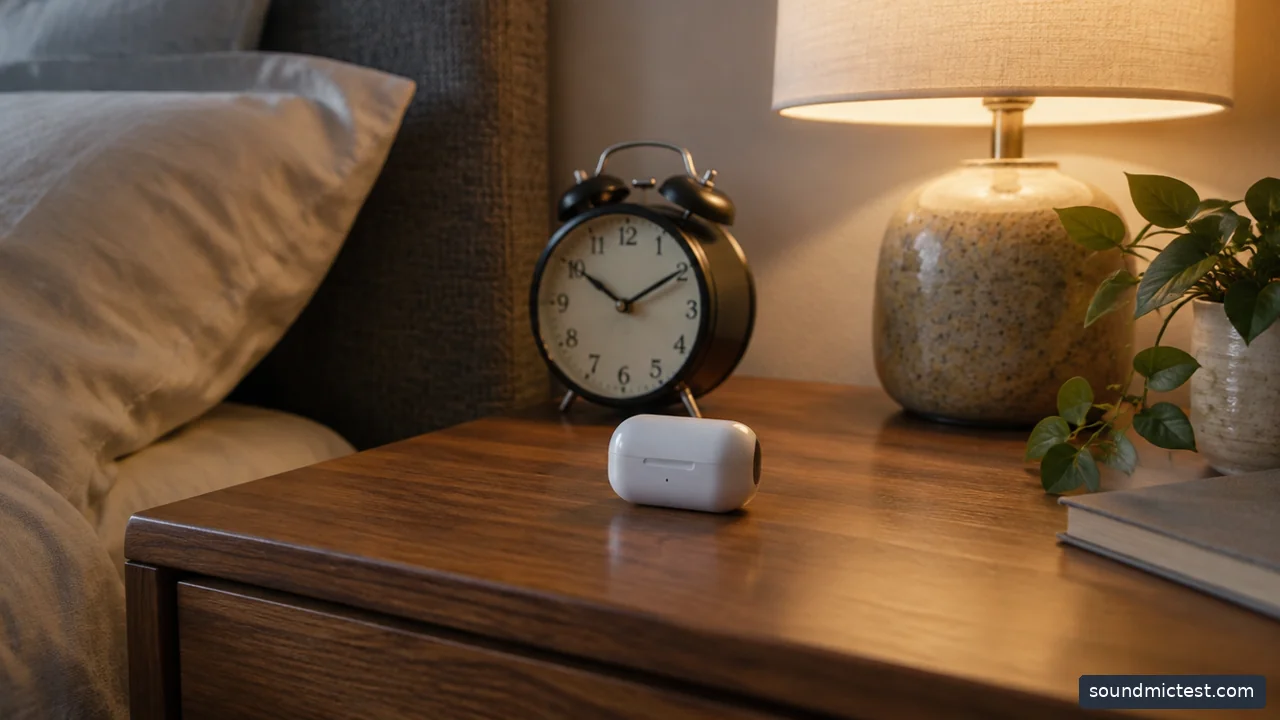
Charging case on nightstand with an analog alarm clock and lamp. Editorial illustration.
Test alarms and playback while awake
Set the desired alarm and verify where it sounds. Check whether it depends on the app or phone and what happens in the selected playback mode. Do not make your first test on a morning when missing the alarm would be costly.
Consider important sounds in the household, including emergency alerts or someone who needs your attention. Noise-isolating audio equipment may not suit every situation. Keep playback low and make a deliberate plan rather than assuming a private alarm covers every requirement.
The stereo test can confirm basic playback, but it cannot evaluate sleep quality. App summaries should also be treated as consumer information rather than a medical diagnosis. Persistent sleep concerns deserve attention beyond changing an audio product.
Choose A20 when masking and its local-playback routine meet the need, and compare A30-family options when ANC is specifically useful. Let pillow comfort, mode-specific battery life and predictable alarms decide the purchase. A sleep earbud should simplify the evening, not add a complicated troubleshooting session to it.