Speakers
Best Bookshelf Speakers for Small Rooms and Desktop Listening
Bookshelf speakers can be an excellent fit for a small room, but the name is misleading. They often work better with some space around them and their drivers aimed toward the listener than pushed into a crowded shelf.

Oliver Reed is an editorial pen name for Sound Mic Test's speaker coverage. Articles explore desktop speakers, stereo placement, connection options and the choices involved in building a listening setup.
Sound Mic Test editorial pen name.
oliver.reed@soundmictest.com
Bookshelf speakers can be an excellent fit for a small room, but the name is misleading. They often work better with some space around them and their drivers aimed toward the listener than pushed into a crowded shelf. For a desktop, connection options and usable placement matter at least as much as cabinet finish.
Edifier R1280T is a straightforward powered option for analog sources. Edifier MR4 is a different starting point when you want to connect recording equipment through balanced inputs. A passive pair can make sense if you already own an appropriate amplifier, but it is not a complete plug-in system by itself. This guide compares setup requirements from manufacturer documentation rather than claiming an acoustic measurement ranking.
Powered or passive comes first
| System | What you need | Best reason to choose it |
|---|---|---|
| Powered stereo pair | Source, signal cable and mains power | Fewer separate boxes |
| Powered monitors with balanced inputs | Compatible interface and cables for that path | Convenient integration with recording equipment |
| Passive speakers | Separate amplifier and speaker cable | Reuse an existing amplifier or upgrade components separately |
| Portable Bluetooth speaker | Compatible wireless source | Portability matters more than a fixed stereo layout |
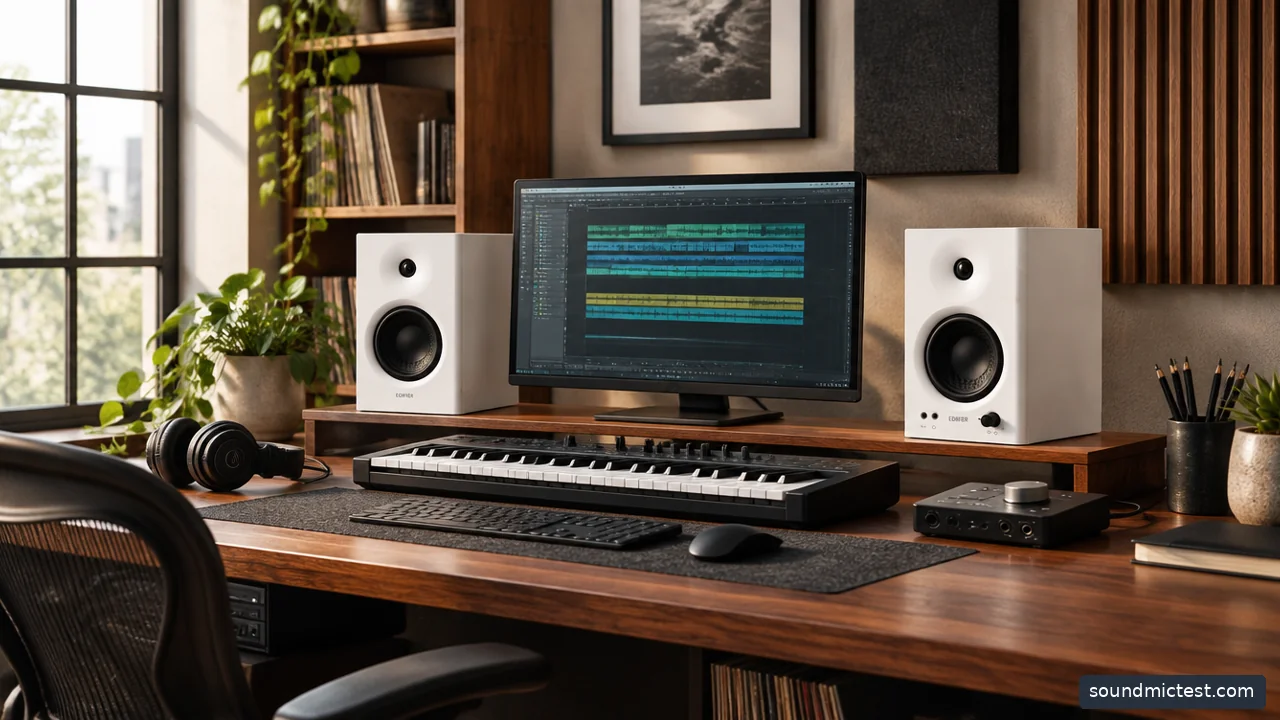
Powered speakers still need the right input connection and space on the desk. Editorial illustration.
R1280T for simple analog listening
Edifier R1280T provides dual RCA inputs in a powered speaker pair. That makes it worth considering for a computer, music player or other source with a suitable analog output.
The important limitation is in the model suffix. Do not assume features found on R1280DB or another related model are present on R1280T. If Bluetooth, optical input or a subwoofer output matters, inspect the exact product page before ordering. Similar-looking cabinets can contain different connection options.
For a turntable, check whether the signal has already passed through a phono preamp. An ordinary line input is not a universal replacement for a phono stage. The correct arrangement depends on the turntable and amplifier functions you already own, not simply whether an RCA plug fits the socket.
MR4 for a desk with an audio interface
The Edifier MR4 includes balanced TRS inputs alongside analog alternatives. That makes it a practical candidate for a small recording desk with an interface offering suitable line outputs.
Balanced connections can be useful in a compatible signal path, but they do not turn an untreated room into a studio. The source output, cable and speaker input must support the intended arrangement. A cable adapter alone does not make an unbalanced source balanced.
The term monitor also is not a guarantee that every mix decision will translate perfectly. Placement, room reflections and listening level remain part of the system. If you are making music, learn how familiar recordings behave through the setup rather than treating a product label as an acoustic certificate.
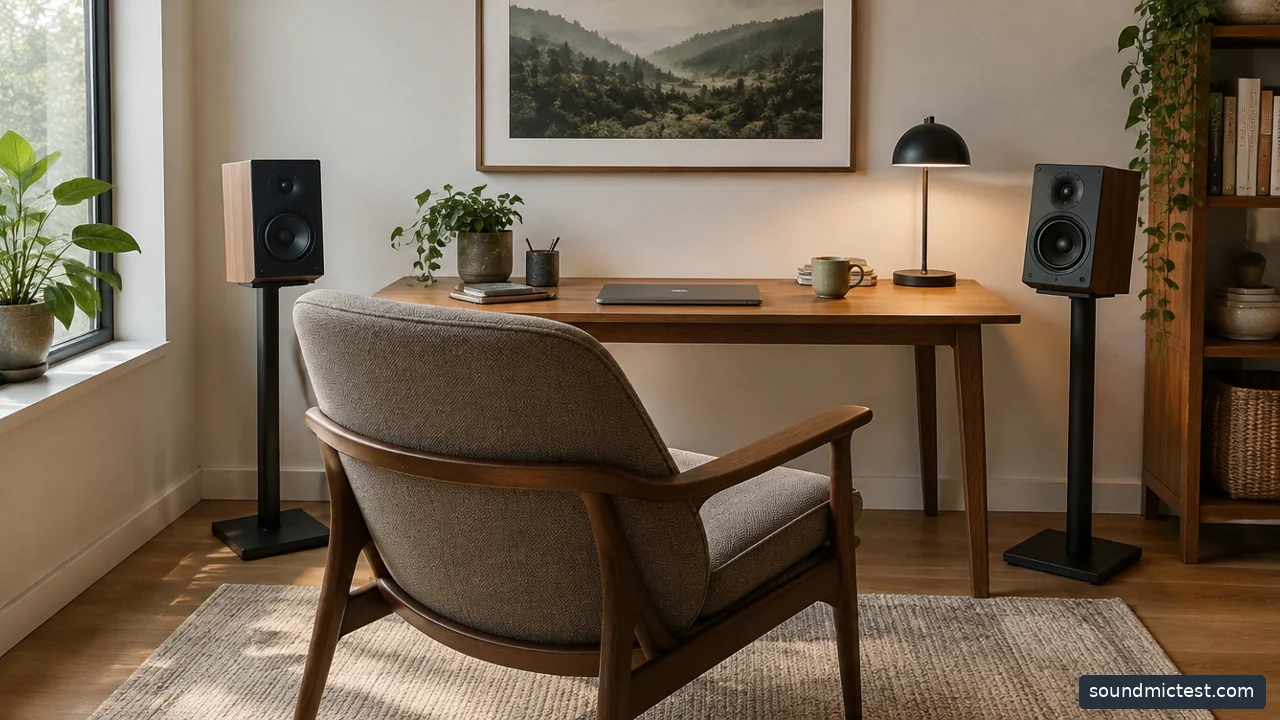
Two compact speakers on desktop stands angled toward the chair. Editorial illustration.
When passive speakers are the better purchase
If you already own a suitable stereo amplifier, a passive bookshelf pair can avoid paying for another set of built-in electronics. Confirm the amplifier's supported load and the speaker manufacturer's recommendations before pairing them. Budget for stands or a suitable shelf position and the correct speaker cable.
For a first computer setup, however, the separate amplifier can add cost and clutter. Compare the complete system against powered alternatives, including a way to control volume conveniently. A low speaker price is not the final price if the rest of the signal chain is missing.
Passive systems also invite gradual upgrades. That can be useful when you have a clear plan, but it can turn a simple desk purchase into an endless search for matching components. Decide whether that flexibility is something you will use.
Give the speakers a workable position
Place the left and right speakers at reasonably similar distances from your normal seat. Aim them toward the listening position and try to bring the tweeters closer to ear height. Small desktop stands can help when the desk surface otherwise points the speakers at your chest.
Leave the clearance specified by the manufacturer, particularly around rear ports and ventilation. Moving a cabinet closer to a wall can change bass balance. If one speaker sits in a corner while the other opens into the room, expect the environment to affect them differently.
Do not stack the pair together and expect meaningful stereo separation. Equally, spreading them to opposite ends of a room while sitting very close to one creates another imbalance. A sensible nearfield layout is usually more useful than an impressive-looking arrangement.
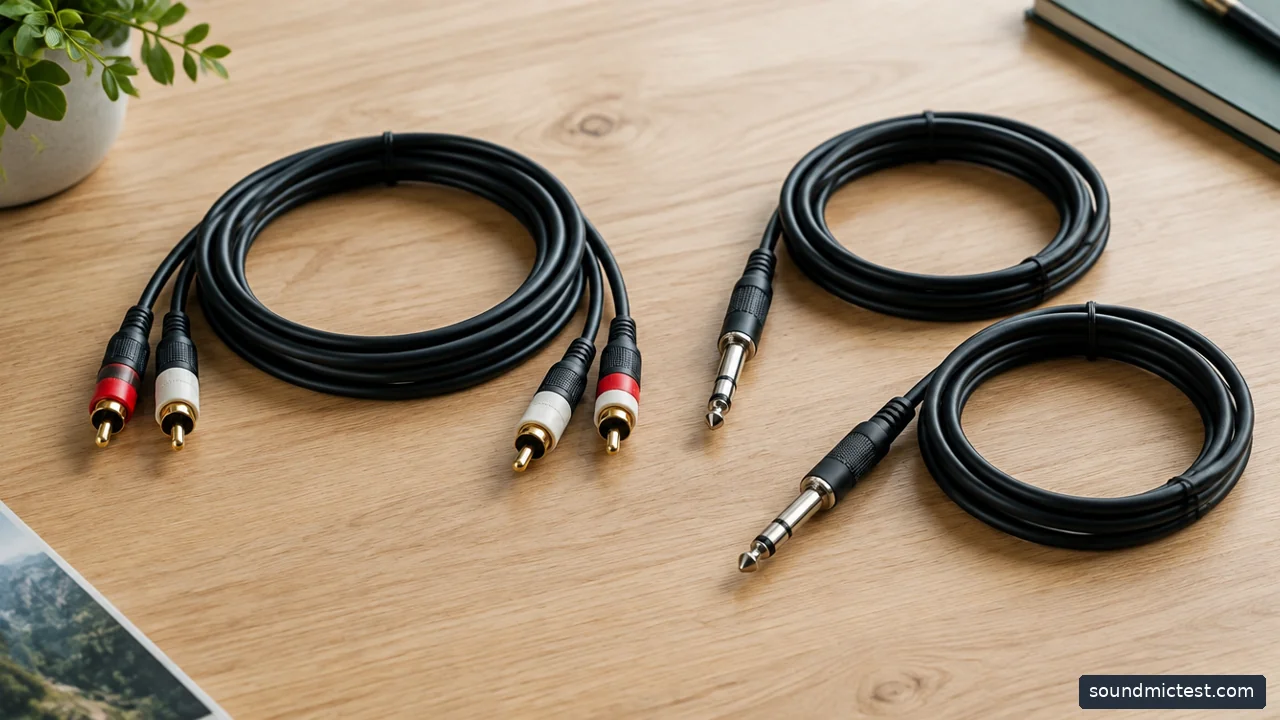
RCA cable and two separate 6.35mm TRS cables on a light wooden desk. Editorial illustration.
Set up and check before evaluating sound
Turn the system down before connecting cables, then select the intended source and input. Use the stereo test to verify left and right orientation. If one side is missing, inspect the source settings and connections before assuming a driver has failed.
The speaker test is a functional listening tool, not a calibrated room measurement. It can confirm playback but cannot tell you whether a frequency-response claim is accurate. Avoid compensating for an inaudible tone by making large volume increases.
Choose R1280T for a simple analog setup, MR4 when its input arrangement fits your interface, or passive speakers when you already have the supporting equipment. In a small room, the best purchase is often the pair you can position correctly and control easily, rather than the biggest cabinet that fits the budget.